Thursday, February 23, 2023

Class 6 Geography Chapter 2 Globe Latitudes and Longitudes

 NCERT Solutions for Class 6 Social Science Geography Chapter 2 Globe Latitudes and Longitudes

1. Answer the following questions briefly:

(a) What is the true shape of the earth?

(b) What is the globe?

(c) What is the latitudinal value of the Tropic of Cancer?

(d) What are the three heat zones of the Earth?

(e) What are parallels of latitude and meridians of longitude?

(f) Why does the Torrid Zone receive the maximum amount of heat?

(g) Why is it 5.30 p.m in India when it is 12.00 noon in London?

Answers:

(a) The true shape of the Earth is geoid-earth like shape. In other words, it is orange shaped.

(b) Globe. Globe is the three dimensional model of the earth.

(c) 2312° N.

(d) Three heat zones of the Earth:-

•Torrid Zone

•Temperate Zone

•Frigid Zone.

(e) Parallels of Latitudes and Meridians of Longitudes:

== Parallels of Latitudes:

All the parallel circles from the equator to the poles are called parallels of latitudes.

== Meridians of Longitudes:

All the semi-circles which join north pole to south pole are termed as meridians of longitudes.

(f) Torrid Zone receives the maximum amount of heat because of the following reasons:

•The Sun shines perpendicular between Tropic of Cancer and Tropic of Capricorn throughout the year.

•Perpendicular sun rays give more heat than slanting sun rays.

(g) It is 5.30 p.m. in India when it is 12.00 noon in London because of the following reasons:

•London is located at 0° longitude while the time of 8212° E longitude is taken as standard time in India.

•There is a difference of 8212 between the longitude of London and the Standard Meridian of India (8212 E).

•Time in India is ahead of London. It is 4 minutes ahead at every longitude towards east.

•Hence time in India is ahead of London by 5.30 hours (4 x 8212 = 330 minutes or 5.30 hours).

2. Tick the correct answer:

(a)The value of the prime meridian is

(i) 90° (ii) 0° (iii) 60°


(b)The frigid zone lies near

(i) the Poles (ii) the Equator (iii) the Tropic of Cancer


(c)The total number of longitudes are

(i) 360 (ii) 180 (iii) 90


(d) The Antarctic Circle is located in

(i) the Northern Hemisphere

(ii) the Southern Hemisphere

(iii) the Eastern Hemisphere


(e) Grid is a network of

(i) parallels of latitudes and meridians of longitudes

(ii) the Tropic of Cancer and the Tropic of Capricorn

(iii) the North Pole and the South Pole


Answers: (a)—(ii), (b)-(i),(c)-(i), (d)-(ii), (e)-(i)

3. Fill in the blanks.

  1. The Tropic of Capricorn is located at…………………..
  2. The Standard Meridian of India is…………………..
  3. The 0° Meridian is also known as…………………..
  4. The distance between the longitudes decreases towards ……………………….
  5. The Arctic Circle is located in the……………….

Answers:

  1. 23 1/2° S
  2. 82 1/2° E
  3. Prime Meridian
  4. Prime Meridian
  5. Northern.

VERY SHORT TYPE QUESTION ANSWER


1. What is the globe?
Answer: Globe is a true model of the earth. It shows the earth in a small form.

2. What are the advantages of the globe? [V. Imp.]
Answer: The globe is small in shape, is convenient to carry and use, and depicts all features of the earth.

3. What are the two types of lines needed to locate any point on the earth’s surface? [V. Imp.]
Answer: Latitudes and longitudes are required to locate any point on the earth’s surface.

4. Define latitude.
Answer: One of the imaginary circles parallel to the Equator is called latitude.

5. Define longitude.
Answer: One of the imaginary circles parallel to the Prime Meridian is called longitude.

6. Which place is used as a standard for a time all over the world?
Answer: Greenwich in Britain is used as a standard for a time all over the world.

7. Geographically, what is the time difference between Dwarka in Gujarat and Dibrugarh in Assam? [Imp]
Answer: The time difference between Dwarka and Dibrugarh is of 1 hour 45 minutes.

8. A particular city lies in the time zone-2. What does this mean?
Answer: This means that the city’s local time is 2 hours behind Greenwich.

9. What does the time ‘12 noon’ signify at any place?
Answer: ‘12 noon’ refers to the time when the sun is at the highest point in the sky.

10. Which heat zone does the equator lie in?
Answer: The equator lies in the Torrid Zone.


LONG TYPE QUESTION ANSWER


1. Why do we have the concept of time zone? [V. Imp.]
Answer: The sun does not shine with the same intensity over all parts of the world at a particular time. If it is overhead at one place (midday), then it does not shine at all (midnight) at the place directly opposite to that place on the earth. So if we have the same time, then 12 noon will mean midday at one place, and midnight at another. To avoid such an awkward system, we have the system of time zones, so that everywhere a particular time means the same stage of the day.
3. Write a short note on Heat Zones. [Imp.]
Answer: Heat zones are the different zones of the earth, where the sun’s rays fall differently, thus causing different climate patterns. These zones are called the Torrid Zone, the two Temperate Zones, and the two Frigid Zones. The Torrid Zone is very hot since the sun shines overhead here. The Temperate Zones maintain a moderate climate, and the Frigid Zones are extremely cold.


5.How do latitudes and longitudes help in locating a point? Why is only one of them insufficient in doing this?[V. Imp.]
Answer: Latitudes and longitudes form a grid. Two different points may lie on the same latitude or the same longitude. But there exists only one point where latitude and longitude intersect. So a point can be identified with the help of the latitude and longitude on which it lies.
EKLAVYA COACHING INSTITUTE 


Class 6 Geography Chapter 1 The Earth in the Solar System

 NCERT Solutions for Class 6 Social Science Geography Chapter 1 The Earth in the Solar System


1. Answer the following questions briefly.

(a) How does a planet differ from a star?

(b) What is meant by the ‘Solar System’?

(c) Name all the planets according to their distance from the sun.

(d) Why is the Earth called a unique planet?

(e) Why do we see only one side of the moon always?

(f) What is the Universe?

1. Answer the following questions briefly.

(a) How does a planet differ from a star?

(b) What is meant by the ‘Solar System’?

(c) Name all the planets according to their distance from the sun.

(d) Why is the Earth called a unique planet?

(e) Why do we see only one side of the moon always?

(f) What is the Universe?


Answer: (a) Differences between a planet and a star:


(b) The term Solar System refers to the “family” of the Sun. The Sun is a star around which eight planets, among other celestial objects, revolve in orbits. This whole system of bodies is called the Solar System. The Sun is the “head” of this system.

(c) The list of planets in the order of their distance from the Sun is as follows:

  • Mercury
  • Venus
  • Earth
  • Mars
  • Jupiter
  • Saturn
  • Uranus
  • Neptune

(d) The Earth is regarded as a unique planet because of the following reasons:

  • It is the only planet known to support life. It has oxygen and water present in proportions that allow life to thrive.
  • It also has a temperature range that supports life.
  • The proportion of water present is about two-thirds of the surface of the earth when compared to land.

(e) One revolution of the moon around the earth takes about 27 days. Incidentally, the moon’s rotation about its own axis also takes nearly the same time. One day of the moon is equal to 27 Earth days. So only one side of the moon can be seen from the earth.

(f) The Universe is the largest unit in which we live. It is a collection of galaxies. There is only one Universe and everything that exists in this Universe itself.

2. Tick the correct answer.

(a) The planet is known as the “Earth’s Twin” is

(i)  Jupiter
(ii) Saturn
(iii) Venus.

(b) Which is the third nearest planet to the sun?
(i) Venus
(ii) Earth
(iii) Mercury.

(c) All the planets move around the sun in a

(i) Circular path

(ii) Rectangular path

(iii) Elongated path

(d) The Pole Star indicates the direction to the

(i) South

(ii) North

(iii) East.

(e) Asteroids are found between the orbits of

(i) Saturn and Jupiter

(ii) Mars and Jupiter

(iii) The Earth and Mars.

Answers: (a)—(iii), (b)—(ii), (c)—(iii), (d)—(ii), (e)—(ii)


3. Fill in the blanks.

A).A group of…….. forming various patterns is called a ………….

B).A huge system of stars is called ……………

C).……….. is the closest celestial body to our earth.

D).………. is the third nearest planet to the sun.

E).Planets do not have their own ………… and ……….

Answers:

A).stars, constellation

B).galaxy

C).The moon

D).The earth

E).heat, light.

            EXTRA QUESTIONS - ANSWERS

1. Name two celestial bodies visible only in the night sky.
Answer: The moon and the stars are celestial bodies visible in the night sky.

2. Why do we not feel the heat and light of the stars, even though they are so big and hot?Answer: We do not feel the heat and light of the stars since they are very far away.

3. From which Greek word is the word ‘planet’ derived?

3. Drive the word planet.

Answer: The word ‘planet’ is derived from the Greek word ‘Planetai’.

4. What does the solar family consist of? [V. Imp.]
Answer:  The solar family consists of the sun, planets, their satellites, and asteroids and meteoroids.

5. What is the shape of the orbits in which planets revolve around the sun?
Answer: The orbits of planets are elliptical (Le. elongated) in shape.

6. Which planet is called “Earth’s twin” and why?
Answer: Venus is called “Earth’s twin” because it is similar to Earth in its shape and size.

7. What is “Geoid”?
Answer: A sphere with its ends flattened at poles (just like earth) is called the geoid.

8. Why is earth called “blue planet”? [V. Imp.]
Answer: Earth appears blue from when seen from the outer space since it has over 2/3rd water. So it is called the blue planet.

9. How much time does the moon take to revolve once around the earth?
Answer: The moon takes approximately 27 days to revolve once around the earth.

10. What is the difference between the moon and INSAT?    [V. Imp.]
Answer: The moon is a natural satellite of the earth while INSAT is an artificial satellite.

11. What are asteroids?
Answer: Asteroids are the numerous tiny celestial bodies which revolve around the sun and are mainly found between the orbits of Mars and Jupiter.

12. What is a meteoroid?
Answer: Small pieces of rocks which move around the sun are called meteoroids.

13. Name the two extreme shapes of the moon. When and at what intervals do they occur?
Answer: The moon is seen in its two extreme shapes on the Full Moon night arid the New Moon night. The Full Moon. The Full Moon means the moon in its full circular shape. The New Moon. The New Moon means the moon that can not be a seer. The New Moon occurs on the fifteenth day and the Full Moon occurs on the last day of the Hindi calendar month.


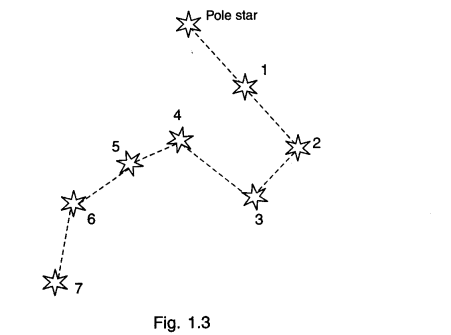
14. What is the Pole Star? How can the Saptarishi be used to locate it?  [Imp.]

Answer: The Pole Star is the star that is known to retain its position in the sky always. We can locate the position of the Pole Star with the help of the constellation Saptarishi. If an imaginary line is drawn joining the “pointer stars” of the Saptarishi and extended further, it will point to the Pole Star.
NCERT Solutions for Class 6 Social Science Geography Chapter 1 The Earth in the Solar System SAQ Q2
1 and 2 represent the “pointer stars”. The Pole Star and the pointer stars lie on the same line.

15. Write a short note on the two planets nearest to the sun.
Answer: Mercury. It is the nearest planet to the sun. It takes just about 88 earth days to revolve once around the sun. It is extremely hot since it is close to the sun. It is also the smallest planet. Venus. It is the second closest planet to the sun. It is similar to earth in shape and size. It is called “Earth’s twin”.

16. How does earth support life?   [V. Imp.]

Answer: The earth has conditions that support life. It is neither too hot nor too cold. It has both water and air, which are both indispensable for life. Presence of oxygen in the air in an appropriate proportion supports life. These factors make the earth a unique planet.

17. Write short notes on the following:
(a) The sun
(b) The moon
(c) Galaxy. [V. Imp.]
Answer:
(a) The sun is considered the “head” of the solar system. It is a star, although it is smaller and less bright than most other stars. It is a huge celestial body made up of extremely hot gases. It provides heat and light for the whole of the solar system. Life on earth depends on many factors, and the sunlight is one of them. The sun is about 150 million kilometers away from the earth.

(b) The moon is the only natural satellite of our planet earth. Its diameter is just about a quarter of the earth’s diameter. It is comparatively closer (3,84,400 kilometers away) to earth than all other celestial bodies. It does not support life. It revolves around the earth and rotates about its own axis in about the same time, due to which only one side of the moon is visible to us.


(c) Galaxy is a term that refers to billions of stars, clouds of dust and gases, and other celestial bodies considered as a single unit. The only bigger unit in the universe, galaxies make up the universe. The galaxy we live in is called the Milky Way.

2. Draw a diagram showing the eight planets of the solar system in their orbits around the’ sun. Also prepare a table mentioning the length of their days and years.
Answer:


Monday, February 13, 2023

Class 7 Civics Chapter 8 Markets Around Us


NCERT Solutions For Class 7 Civics Social Science Chapter 8 Markets Around Us


1. In what ways is a hawker different from a shop owner?
Answer: A hawker provides door to door service. He sells his goods by calling out the names of his items. He generally owns a the which we may call a movable shop and keeps in it different items of our everyday use. He sells his goods at a minimum profit.

A shop owner runs his shop at one fixed place. Whenever we need anything we go there and purchase it. Here, we get things at a somewhat costlier rate.

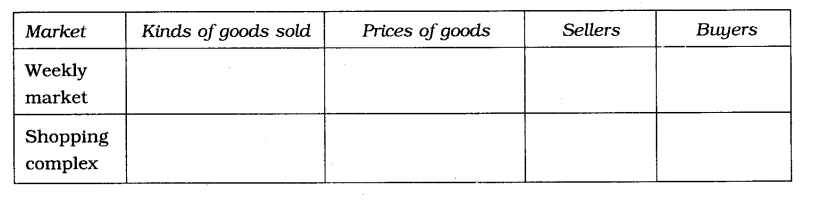
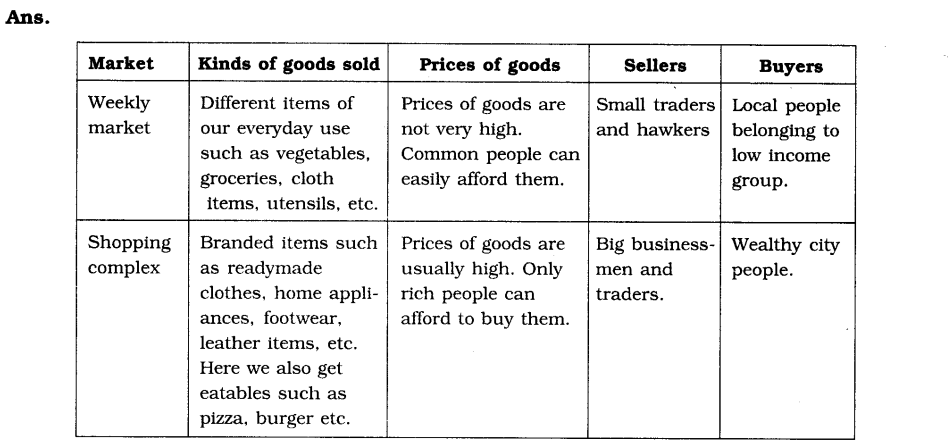
2. Compare and contrast a weekly market and a shopping complex on the following:
NCERT Solutions For Class 7 Civics Social Science Chapter 8 Markets Around Us Q2
NCERT Solutions For Class 7 Civics Social Science Chapter 8 Markets Around Us Q2.1

3. Explain how a chain of markets is formed. What purpose does it serve?
Answer: Goods are produced in factories, Goods are also produced in farms and in homes. But we are not required to go to factories or farms to buy goods of our need, because the producers are not interested in selling us small quantities. The wholesale traders do this job. They are the people who come in between the producer and the final consumer. They first buy goods in bulk. Then they sell these goods to the retailers, who finally sell this to the consumers.
From the above instance we come to the conclusion that from factories to final consumers a chain is formed, which we may call a chain of markets. We can better understand it through the flow chart given below:
NCERT Solutions For Class 7 Civics Social Science Chapter 8 Markets Around Us Q3
It serves a great purpose. It maintains the flow of money. It makes easy availability of various items of our daily use. It also promotes coordination in society

4. ‘All persons have equal rights to visit any shop in a marketplace.’ Do you think this is true of shops with expensive products? Explain with examples.
Answer: It is true that all persons have equal rights to visit any shop in the marketplace. But this is not true of shops with expensive products. It is because of the following:

  1. People with high incomes can buy expensive products. Hence, these people go to the shops with expensive products and not the poor or people with low income.
  2. The low-income group people visit the shops or weekly markets to buy goods as these goods are available at cheaper rates.

Examples:
People with high income buy green vegetables from multiplexes or malls while poor people purchase green vegetables from small vegetable sellers or from hawkers.

5. ‘Buying and selling can take place without going to a marketplace’. Explain this statement with the help of examples.
Answer:
It is correct that buying and selling can take place without going to a market place. It is done in the following manner.
Examples:

  • We can order goods that we need over the telephone and get their delivery.
  • Over the internet, we can visit the concerned website and order the products.
  • We can pay through internet banking or on the delivery of goods.


VERY SHORT ANSWER TYPE QUESTIONS

1. Why is a weekly market called so?
Answer: A weekly market is called so because it is held a specific day of the week.

2. Why is there a competition among the shops in the weekly market? [V. Imp.]
Answer: In the weekly market there are many shops that sell the same goods. This creates competition among them.

3. Who is Scunner? What does he do?
Answer: Sameer is a small trader in the weekly market. He buys clothes from a large trader and sells them in six different markets in a week.

4. Give some examples of roadside stalls.
Answer: Vegetable hawker, fruit vendor, mechanic.

5. How are shops in the neighbourhood useful?

Answer: These types of shops are close to our home and we can go there any time. As the buyer and seller know each other these shops also provide goods on credit.

6. Where are the goods produced?

Answer: Goods are produced in factories, on farms, and in homes.

7. Why do we not buy directly from the producer? [V. Imp.]

Answer: It is because the producer is not interested in selling goods in small quantities. 

8. Who is a retailer? [Imp.]

Answer: A retailer is a small trader who buys goods from the wholesale trader and sells this to the consumer.

9. Who is Aftab?

Answer: Aftab is a wholesaler in the city. He purchases vegetables in bulk and sells them to hawkers and shopkeepers.

10. How are buyers, different people?

Answer: There are many buyers who cannot afford even the cheapest of goods. While others frequently visit malls and buy different items.

11. What is done in the wholesale markets?

Ans. This is where goods first reach and are then supplied to other traders.


SHORT ANSWER TYPE QUESTIONS

1. Write in brief about shopping complexes and malls.

Answer: Shopping complexes and malls are usually found in urban areas. These are large multi-storeyed air-conditioned buildings with shops on different floors. These shops sell both branded and non-branded goods. Fewer people visit malls because they sell costly items. Only well-to-do people can afford to buy these items.

2. What is the job of a wholesale trader? [V. Imp.]

Answer: A wholesale trader buys goods from the producer in large quantities. He then sells them to other traders, say small traders. These small traders sell different items to the final consumer. Thus, the wholesale trader establishes link between the producer and the consumer. It is through these links of traders that goods reach faraway places.

3. How are shop owners in a weekly market and those in a shopping complex very different people? [V. Imp.]

Answer: Both are undoubtedly different people.

(a) The shop owners in a weekly market are small traders who run their shop with little money. On the other hand, the shop owners of a shopping complex are big parties. They have a lot of money to spend on their shops.

(b) What these two types of shop owners earn is also not equal. The weekly market trader earns little compared to the profit of a regular shop owner in a shopping complex.

4. Write a brief note on ‘Aftab—the wholesaler in the city’.

Answer: Aftab is a wholesaler of vegetables. His work usually starts at around 2 o’clock in the early morning. This is the time when vegetables reach the market or mandi and with them start the activities. The vegetables come in trucks, matadors, etc. and soon the process of auctions begins. Aftab participates in this auction and decides what he will buy. He buys vegetables in bulk. After that, he sells them to hawkers and shopkeepers who usually come to him around six in the morning.

I'm having Fun by playing Ludo, Carrom Online. Join me using my link and get Rs.50 on Signup. Win Daily and Get Withdrawals in less than 60 secs. Hurry! Use my referral link: https://rushbyhike.app.link/EejDjSxxwxb

LONG ANSWER TYPE QUESTIONS

1. Do you see equality in the market? If not, why not? Explain with examples.[V. Imp.]

Or

Write in brief on ‘market and equality’.

Answer: We do not see equality in the market. Big and powerful business persons earn huge profits while small traders earn very little. For example, the shop owners in a weekly market and those in a shopping complex are two different people. One is a small trader who has little money to run the shop. Whereas the other has a lot of money to spend on the shop. The earning of these two people is also unequal. The weekly market trader earns little profit whereas the shopping complex owner gains huge income.

Not only the shop owners are different people, but also the buyers. In the market we see different types of buyers There are several buyers who Eire not able to afford even the cheapest of goods white others are busy shopping for different luxurious items in malls. Thus, we see no equality in the market place.

Class 7 Civics chapter 7 Understanding Advertising

 NCERT Solutions For Class 7 Civics Social Science Chapter 7 Understanding Advertising


VERY SHORT ANSWER TYPE QUESTIONS

1. What do advertisements do?
Answer: They attract people’s attention to their products.

2. What do you mean by the word branding?
Answer: The naming of a product is called branding.

3. Why is the consumer confused? Or What makes the consumer confused?[V. Imp.]
Answer: Sometimes there are two or more advertisements of a similar product. This makes the consumer confused because it becomes difficult for him to differentiate one product from the other/others.

4. What do the advertisers do to convince the consumer?
Answer: They start claiming certain special values for their brand.

5. How are brand values conveyed to us?
Answer: Brand values are conveyed to us through the use of visuals and words.

6. When products are advertised by cricket heroes and film stars, we feel tempted to buy them. Why?
Answer: It is because persons whom we consider our heroes tell us that those products are worth buying.

7. Advertisements aim to get people to buy a particular brand’. What does this really mean?
Answer: It means that after we see an advertisement we should want to buy the brand

8. Why do companies show the advertisements again and again?
Ans. They do so in order to get it to stick in people’s minds.

9. Under what pressure do companies show the advertisements again and again?
Answer: There are so many advertisements in the market. This creates pressure on the companies and they start showing the advertisements, again and again, to make it most popular.

10. What do you mean by social advertisements?   [V. Imp.]
Answer: Social advertisements are advertisements made by the State or private agencies.
These advertisements have a larger message for the society.

11. What impressions does advertising create on us?
Answer: It creates the impressions that things that are packaged are better than things that are sold loose.

12. Mention one drawback of advertising.
Answer: It tends to promote a certain lack of respect for the poor.

13. How do people feel when they fail to afford certain brands?
Answer: They feel bad about their helplessness to buy certain brands.


SHORT ANSWER TYPE QUESTIONS

1. Why do you think the manufacturer of the daal (pulses) gave his product a specific name?  [Imp.]
Answer: Daals (pulses) are usually sold loose in the market. There are different types of daals in the market such as arahar ki daal, masoor ki dual, urad ki daal, etc. These names are not brand names. When a company takes particular daal such as urad ki daal and puts it into a packet, it will need to give the daal a specific name. It needs to do this so that we don’t confuse the daal is that particular packet with the daal that is sold loose.

2. What do companies do in case there are two brands of a similar product?

Answer: In such a situation the consumer is confused. He cannot decide which product he should buy. The manufacturer, being aware of this has to give the consumer a reason to refer a particular brand of a product. Just naming a product does not help sell it. So, advertisers began claiming certain special values for their brand. In this way, they try to differentiate it from other similar products.

3. What brand values are used by the two daals namely Top Taste Daal’ and ‘Best Taste Daal’?Answer: The two daals namely Top Taste Daal’ and ‘Best Taste Daal’ are saying two different things. Top Taste Daal is appealing to our social tradition of treating guests extremely well. On the other hand ‘Best Taste Daal is appealing to our concern for our children’s health and that they eat things that are good for them. Values such as treating our guests well and making sure and children get nutritious food are used by brands to create brand values. These brand values are conveyed through the use of visuals and words to give us an overall image that appeals to us.

4. How is personal emotion being used in the Care Soap advertisement? [Imp.]

Answer: The Care Soap advertisement uses the mother’s concern for her child. It tells the mother that her love and care is best shown through using this particular brand of soap. Because of this, mothers begin to feel that using this soap is a sign of how much they love their child. In this way, the advertisement uses the love of a mother for her child to sell this expensive soap.

Just think about those mothers who cannot afford this soap. They might begin to feel that they are not giving their children the best care.

5. What role do advertisements play in our lives? [V. Imp.]

Answer: Advertisements play a major role in our lives. They influence us to a great extent. We watch advertisements, discuss them, and often judge people according to the brand products they use. Whenever we see cricket heroes and film stars advertising different products we feel tempted to buy those products. It is because persons whom we consider our heroes tell us that they are worth buying.

Advertisements tell us how we should live our lives, what we should aspire and dream for, how we should express our love, what it means to be smart, successful, and beautiful. Thus, advertisements have a significant role in our lives. In the present scenario, we cannot think of life without advertisements.


LONG ANSWER TYPE QUESTIONS

1. How are small businessmen affected in this age of advertisements? [V. Imp.]

Answer: Advertising a product is a costly affair no doubt but this is the only way to sell products in the market. Large companies have no dearth to money and therefore they can easily advertise their products. But these are small businessmen also who have no money to show their products on television or national newspapers and magazines. They often have to sell their products in weekly markets and neighbourhood shops.

Advertising also makes us believe that packaged and branded things are better than things sold loose. We often forget that the quality of a product has little to do with the packaging that it comes in. This shift to packaged products negatively affects the sales of several small businesses forcing people out of their livelihoods.

2. Mention the drawbacks of advertising. [V. Imp.]

Answer: Advertising shows certain drawbacks which are as follow:

(a) We are citizens of a democratic country. It means we all are equal. But advertising always focuses on the lives of the rich and influential persons. It tends to promote a certain lack of respect for the poor. They are not the faces we most often see in advertisements and therefore we cease to think about them.

(b) Advertising uses the personal emotions of the people. Those who are capable to buy certain brands feel exalted but there are many who cannot afford to buy them. The personal emotions of these people are hurt badly.

(c) Advertising promotes the sale of packaged products. This negatively affects the sale of things which do not come in packets. This forces many people out of their livelihoods.

(d) Advertising by focussing on the lives of the rich and famous helps us forget about issues of poverty, discrimination, and dignity, all of which are central to the functioning of equality in a democracy.


India's Role in the Global World

 India's Role in the Global World Introduction: India, the world's largest democracy and a vibrant, diverse nation, plays a pivotal ...