Thursday, February 23, 2023

Class 6 Geography Chapter 2 Globe Latitudes and Longitudes

 NCERT Solutions for Class 6 Social Science Geography Chapter 2 Globe Latitudes and Longitudes

1. Answer the following questions briefly:

(a) What is the true shape of the earth?

(b) What is the globe?

(c) What is the latitudinal value of the Tropic of Cancer?

(d) What are the three heat zones of the Earth?

(e) What are parallels of latitude and meridians of longitude?

(f) Why does the Torrid Zone receive the maximum amount of heat?

(g) Why is it 5.30 p.m in India when it is 12.00 noon in London?

Answers:

(a) The true shape of the Earth is geoid-earth like shape. In other words, it is orange shaped.

(b) Globe. Globe is the three dimensional model of the earth.

(c) 2312° N.

(d) Three heat zones of the Earth:-

•Torrid Zone

•Temperate Zone

•Frigid Zone.

(e) Parallels of Latitudes and Meridians of Longitudes:

== Parallels of Latitudes:

All the parallel circles from the equator to the poles are called parallels of latitudes.

== Meridians of Longitudes:

All the semi-circles which join north pole to south pole are termed as meridians of longitudes.

(f) Torrid Zone receives the maximum amount of heat because of the following reasons:

•The Sun shines perpendicular between Tropic of Cancer and Tropic of Capricorn throughout the year.

•Perpendicular sun rays give more heat than slanting sun rays.

(g) It is 5.30 p.m. in India when it is 12.00 noon in London because of the following reasons:

•London is located at 0° longitude while the time of 8212° E longitude is taken as standard time in India.

•There is a difference of 8212 between the longitude of London and the Standard Meridian of India (8212 E).

•Time in India is ahead of London. It is 4 minutes ahead at every longitude towards east.

•Hence time in India is ahead of London by 5.30 hours (4 x 8212 = 330 minutes or 5.30 hours).

2. Tick the correct answer:

(a)The value of the prime meridian is

(i) 90° (ii) 0° (iii) 60°


(b)The frigid zone lies near

(i) the Poles (ii) the Equator (iii) the Tropic of Cancer


(c)The total number of longitudes are

(i) 360 (ii) 180 (iii) 90


(d) The Antarctic Circle is located in

(i) the Northern Hemisphere

(ii) the Southern Hemisphere

(iii) the Eastern Hemisphere


(e) Grid is a network of

(i) parallels of latitudes and meridians of longitudes

(ii) the Tropic of Cancer and the Tropic of Capricorn

(iii) the North Pole and the South Pole


Answers: (a)—(ii), (b)-(i),(c)-(i), (d)-(ii), (e)-(i)

3. Fill in the blanks.

  1. The Tropic of Capricorn is located at…………………..
  2. The Standard Meridian of India is…………………..
  3. The 0° Meridian is also known as…………………..
  4. The distance between the longitudes decreases towards ……………………….
  5. The Arctic Circle is located in the……………….

Answers:

  1. 23 1/2° S
  2. 82 1/2° E
  3. Prime Meridian
  4. Prime Meridian
  5. Northern.

VERY SHORT TYPE QUESTION ANSWER


1. What is the globe?
Answer: Globe is a true model of the earth. It shows the earth in a small form.

2. What are the advantages of the globe? [V. Imp.]
Answer: The globe is small in shape, is convenient to carry and use, and depicts all features of the earth.

3. What are the two types of lines needed to locate any point on the earth’s surface? [V. Imp.]
Answer: Latitudes and longitudes are required to locate any point on the earth’s surface.

4. Define latitude.
Answer: One of the imaginary circles parallel to the Equator is called latitude.

5. Define longitude.
Answer: One of the imaginary circles parallel to the Prime Meridian is called longitude.

6. Which place is used as a standard for a time all over the world?
Answer: Greenwich in Britain is used as a standard for a time all over the world.

7. Geographically, what is the time difference between Dwarka in Gujarat and Dibrugarh in Assam? [Imp]
Answer: The time difference between Dwarka and Dibrugarh is of 1 hour 45 minutes.

8. A particular city lies in the time zone-2. What does this mean?
Answer: This means that the city’s local time is 2 hours behind Greenwich.

9. What does the time ‘12 noon’ signify at any place?
Answer: ‘12 noon’ refers to the time when the sun is at the highest point in the sky.

10. Which heat zone does the equator lie in?
Answer: The equator lies in the Torrid Zone.


LONG TYPE QUESTION ANSWER


1. Why do we have the concept of time zone? [V. Imp.]
Answer: The sun does not shine with the same intensity over all parts of the world at a particular time. If it is overhead at one place (midday), then it does not shine at all (midnight) at the place directly opposite to that place on the earth. So if we have the same time, then 12 noon will mean midday at one place, and midnight at another. To avoid such an awkward system, we have the system of time zones, so that everywhere a particular time means the same stage of the day.
3. Write a short note on Heat Zones. [Imp.]
Answer: Heat zones are the different zones of the earth, where the sun’s rays fall differently, thus causing different climate patterns. These zones are called the Torrid Zone, the two Temperate Zones, and the two Frigid Zones. The Torrid Zone is very hot since the sun shines overhead here. The Temperate Zones maintain a moderate climate, and the Frigid Zones are extremely cold.


5.How do latitudes and longitudes help in locating a point? Why is only one of them insufficient in doing this?[V. Imp.]
Answer: Latitudes and longitudes form a grid. Two different points may lie on the same latitude or the same longitude. But there exists only one point where latitude and longitude intersect. So a point can be identified with the help of the latitude and longitude on which it lies.
EKLAVYA COACHING INSTITUTE 


Class 6 Geography Chapter 1 The Earth in the Solar System

 NCERT Solutions for Class 6 Social Science Geography Chapter 1 The Earth in the Solar System


1. Answer the following questions briefly.

(a) How does a planet differ from a star?

(b) What is meant by the ‘Solar System’?

(c) Name all the planets according to their distance from the sun.

(d) Why is the Earth called a unique planet?

(e) Why do we see only one side of the moon always?

(f) What is the Universe?

1. Answer the following questions briefly.

(a) How does a planet differ from a star?

(b) What is meant by the ‘Solar System’?

(c) Name all the planets according to their distance from the sun.

(d) Why is the Earth called a unique planet?

(e) Why do we see only one side of the moon always?

(f) What is the Universe?


Answer: (a) Differences between a planet and a star:


(b) The term Solar System refers to the “family” of the Sun. The Sun is a star around which eight planets, among other celestial objects, revolve in orbits. This whole system of bodies is called the Solar System. The Sun is the “head” of this system.

(c) The list of planets in the order of their distance from the Sun is as follows:

  • Mercury
  • Venus
  • Earth
  • Mars
  • Jupiter
  • Saturn
  • Uranus
  • Neptune

(d) The Earth is regarded as a unique planet because of the following reasons:

  • It is the only planet known to support life. It has oxygen and water present in proportions that allow life to thrive.
  • It also has a temperature range that supports life.
  • The proportion of water present is about two-thirds of the surface of the earth when compared to land.

(e) One revolution of the moon around the earth takes about 27 days. Incidentally, the moon’s rotation about its own axis also takes nearly the same time. One day of the moon is equal to 27 Earth days. So only one side of the moon can be seen from the earth.

(f) The Universe is the largest unit in which we live. It is a collection of galaxies. There is only one Universe and everything that exists in this Universe itself.

2. Tick the correct answer.

(a) The planet is known as the “Earth’s Twin” is

(i)  Jupiter
(ii) Saturn
(iii) Venus.

(b) Which is the third nearest planet to the sun?
(i) Venus
(ii) Earth
(iii) Mercury.

(c) All the planets move around the sun in a

(i) Circular path

(ii) Rectangular path

(iii) Elongated path

(d) The Pole Star indicates the direction to the

(i) South

(ii) North

(iii) East.

(e) Asteroids are found between the orbits of

(i) Saturn and Jupiter

(ii) Mars and Jupiter

(iii) The Earth and Mars.

Answers: (a)—(iii), (b)—(ii), (c)—(iii), (d)—(ii), (e)—(ii)


3. Fill in the blanks.

A).A group of…….. forming various patterns is called a ………….

B).A huge system of stars is called ……………

C).……….. is the closest celestial body to our earth.

D).………. is the third nearest planet to the sun.

E).Planets do not have their own ………… and ……….

Answers:

A).stars, constellation

B).galaxy

C).The moon

D).The earth

E).heat, light.

            EXTRA QUESTIONS - ANSWERS

1. Name two celestial bodies visible only in the night sky.
Answer: The moon and the stars are celestial bodies visible in the night sky.

2. Why do we not feel the heat and light of the stars, even though they are so big and hot?Answer: We do not feel the heat and light of the stars since they are very far away.

3. From which Greek word is the word ‘planet’ derived?

3. Drive the word planet.

Answer: The word ‘planet’ is derived from the Greek word ‘Planetai’.

4. What does the solar family consist of? [V. Imp.]
Answer:  The solar family consists of the sun, planets, their satellites, and asteroids and meteoroids.

5. What is the shape of the orbits in which planets revolve around the sun?
Answer: The orbits of planets are elliptical (Le. elongated) in shape.

6. Which planet is called “Earth’s twin” and why?
Answer: Venus is called “Earth’s twin” because it is similar to Earth in its shape and size.

7. What is “Geoid”?
Answer: A sphere with its ends flattened at poles (just like earth) is called the geoid.

8. Why is earth called “blue planet”? [V. Imp.]
Answer: Earth appears blue from when seen from the outer space since it has over 2/3rd water. So it is called the blue planet.

9. How much time does the moon take to revolve once around the earth?
Answer: The moon takes approximately 27 days to revolve once around the earth.

10. What is the difference between the moon and INSAT?    [V. Imp.]
Answer: The moon is a natural satellite of the earth while INSAT is an artificial satellite.

11. What are asteroids?
Answer: Asteroids are the numerous tiny celestial bodies which revolve around the sun and are mainly found between the orbits of Mars and Jupiter.

12. What is a meteoroid?
Answer: Small pieces of rocks which move around the sun are called meteoroids.

13. Name the two extreme shapes of the moon. When and at what intervals do they occur?
Answer: The moon is seen in its two extreme shapes on the Full Moon night arid the New Moon night. The Full Moon. The Full Moon means the moon in its full circular shape. The New Moon. The New Moon means the moon that can not be a seer. The New Moon occurs on the fifteenth day and the Full Moon occurs on the last day of the Hindi calendar month.


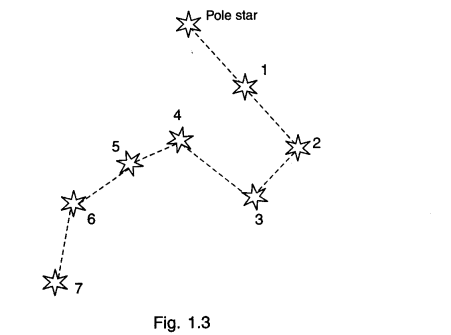
14. What is the Pole Star? How can the Saptarishi be used to locate it?  [Imp.]

Answer: The Pole Star is the star that is known to retain its position in the sky always. We can locate the position of the Pole Star with the help of the constellation Saptarishi. If an imaginary line is drawn joining the “pointer stars” of the Saptarishi and extended further, it will point to the Pole Star.
NCERT Solutions for Class 6 Social Science Geography Chapter 1 The Earth in the Solar System SAQ Q2
1 and 2 represent the “pointer stars”. The Pole Star and the pointer stars lie on the same line.

15. Write a short note on the two planets nearest to the sun.
Answer: Mercury. It is the nearest planet to the sun. It takes just about 88 earth days to revolve once around the sun. It is extremely hot since it is close to the sun. It is also the smallest planet. Venus. It is the second closest planet to the sun. It is similar to earth in shape and size. It is called “Earth’s twin”.

16. How does earth support life?   [V. Imp.]

Answer: The earth has conditions that support life. It is neither too hot nor too cold. It has both water and air, which are both indispensable for life. Presence of oxygen in the air in an appropriate proportion supports life. These factors make the earth a unique planet.

17. Write short notes on the following:
(a) The sun
(b) The moon
(c) Galaxy. [V. Imp.]
Answer:
(a) The sun is considered the “head” of the solar system. It is a star, although it is smaller and less bright than most other stars. It is a huge celestial body made up of extremely hot gases. It provides heat and light for the whole of the solar system. Life on earth depends on many factors, and the sunlight is one of them. The sun is about 150 million kilometers away from the earth.

(b) The moon is the only natural satellite of our planet earth. Its diameter is just about a quarter of the earth’s diameter. It is comparatively closer (3,84,400 kilometers away) to earth than all other celestial bodies. It does not support life. It revolves around the earth and rotates about its own axis in about the same time, due to which only one side of the moon is visible to us.


(c) Galaxy is a term that refers to billions of stars, clouds of dust and gases, and other celestial bodies considered as a single unit. The only bigger unit in the universe, galaxies make up the universe. The galaxy we live in is called the Milky Way.

2. Draw a diagram showing the eight planets of the solar system in their orbits around the’ sun. Also prepare a table mentioning the length of their days and years.
Answer:


India's Role in the Global World

 India's Role in the Global World Introduction: India, the world's largest democracy and a vibrant, diverse nation, plays a pivotal ...