Monday, February 13, 2023

Class 7 Civics Chapter 8 Markets Around Us


NCERT Solutions For Class 7 Civics Social Science Chapter 8 Markets Around Us


1. In what ways is a hawker different from a shop owner?
Answer: A hawker provides door to door service. He sells his goods by calling out the names of his items. He generally owns a the which we may call a movable shop and keeps in it different items of our everyday use. He sells his goods at a minimum profit.

A shop owner runs his shop at one fixed place. Whenever we need anything we go there and purchase it. Here, we get things at a somewhat costlier rate.

2. Compare and contrast a weekly market and a shopping complex on the following:
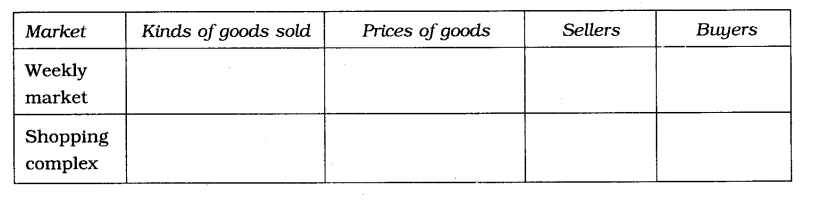
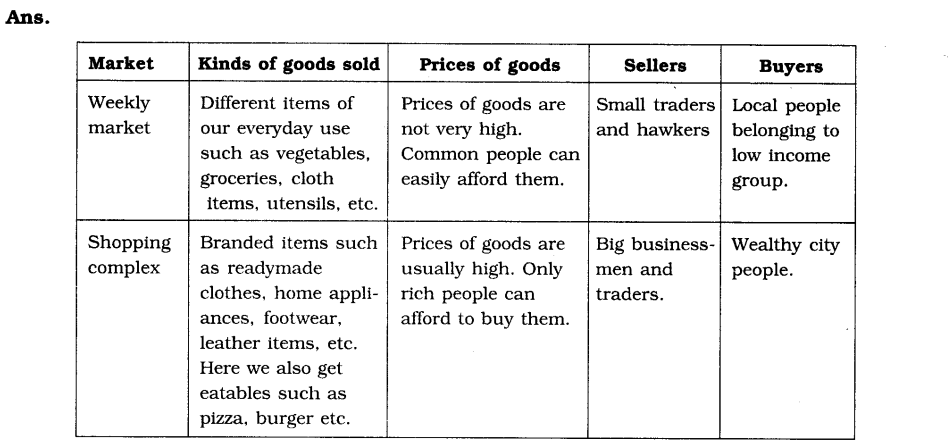
NCERT Solutions For Class 7 Civics Social Science Chapter 8 Markets Around Us Q2
NCERT Solutions For Class 7 Civics Social Science Chapter 8 Markets Around Us Q2.1

3. Explain how a chain of markets is formed. What purpose does it serve?
Answer: Goods are produced in factories, Goods are also produced in farms and in homes. But we are not required to go to factories or farms to buy goods of our need, because the producers are not interested in selling us small quantities. The wholesale traders do this job. They are the people who come in between the producer and the final consumer. They first buy goods in bulk. Then they sell these goods to the retailers, who finally sell this to the consumers.
From the above instance we come to the conclusion that from factories to final consumers a chain is formed, which we may call a chain of markets. We can better understand it through the flow chart given below:

NCERT Solutions For Class 7 Civics Social Science Chapter 8 Markets Around Us Q3
It serves a great purpose. It maintains the flow of money. It makes easy availability of various items of our daily use. It also promotes coordination in society

4. ‘All persons have equal rights to visit any shop in a marketplace.’ Do you think this is true of shops with expensive products? Explain with examples.
Answer: It is true that all persons have equal rights to visit any shop in the marketplace. But this is not true of shops with expensive products. It is because of the following:

  1. People with high incomes can buy expensive products. Hence, these people go to the shops with expensive products and not the poor or people with low income.
  2. The low-income group people visit the shops or weekly markets to buy goods as these goods are available at cheaper rates.

Examples:
People with high income buy green vegetables from multiplexes or malls while poor people purchase green vegetables from small vegetable sellers or from hawkers.

5. ‘Buying and selling can take place without going to a marketplace’. Explain this statement with the help of examples.
Answer:
It is correct that buying and selling can take place without going to a market place. It is done in the following manner.
Examples:

  • We can order goods that we need over the telephone and get their delivery.
  • Over the internet, we can visit the concerned website and order the products.
  • We can pay through internet banking or on the delivery of goods.


VERY SHORT ANSWER TYPE QUESTIONS

1. Why is a weekly market called so?
Answer: A weekly market is called so because it is held a specific day of the week.

2. Why is there a competition among the shops in the weekly market? [V. Imp.]
Answer: In the weekly market there are many shops that sell the same goods. This creates competition among them.

3. Who is Scunner? What does he do?
Answer: Sameer is a small trader in the weekly market. He buys clothes from a large trader and sells them in six different markets in a week.

4. Give some examples of roadside stalls.
Answer: Vegetable hawker, fruit vendor, mechanic.

5. How are shops in the neighbourhood useful?

Answer: These types of shops are close to our home and we can go there any time. As the buyer and seller know each other these shops also provide goods on credit.

6. Where are the goods produced?

Answer: Goods are produced in factories, on farms, and in homes.

7. Why do we not buy directly from the producer? [V. Imp.]

Answer: It is because the producer is not interested in selling goods in small quantities. 

8. Who is a retailer? [Imp.]

Answer: A retailer is a small trader who buys goods from the wholesale trader and sells this to the consumer.

9. Who is Aftab?

Answer: Aftab is a wholesaler in the city. He purchases vegetables in bulk and sells them to hawkers and shopkeepers.

10. How are buyers, different people?

Answer: There are many buyers who cannot afford even the cheapest of goods. While others frequently visit malls and buy different items.

11. What is done in the wholesale markets?

Ans. This is where goods first reach and are then supplied to other traders.


SHORT ANSWER TYPE QUESTIONS

1. Write in brief about shopping complexes and malls.

Answer: Shopping complexes and malls are usually found in urban areas. These are large multi-storeyed air-conditioned buildings with shops on different floors. These shops sell both branded and non-branded goods. Fewer people visit malls because they sell costly items. Only well-to-do people can afford to buy these items.

2. What is the job of a wholesale trader? [V. Imp.]

Answer: A wholesale trader buys goods from the producer in large quantities. He then sells them to other traders, say small traders. These small traders sell different items to the final consumer. Thus, the wholesale trader establishes link between the producer and the consumer. It is through these links of traders that goods reach faraway places.

3. How are shop owners in a weekly market and those in a shopping complex very different people? [V. Imp.]

Answer: Both are undoubtedly different people.

(a) The shop owners in a weekly market are small traders who run their shop with little money. On the other hand, the shop owners of a shopping complex are big parties. They have a lot of money to spend on their shops.

(b) What these two types of shop owners earn is also not equal. The weekly market trader earns little compared to the profit of a regular shop owner in a shopping complex.

4. Write a brief note on ‘Aftab—the wholesaler in the city’.

Answer: Aftab is a wholesaler of vegetables. His work usually starts at around 2 o’clock in the early morning. This is the time when vegetables reach the market or mandi and with them start the activities. The vegetables come in trucks, matadors, etc. and soon the process of auctions begins. Aftab participates in this auction and decides what he will buy. He buys vegetables in bulk. After that, he sells them to hawkers and shopkeepers who usually come to him around six in the morning.

I'm having Fun by playing Ludo, Carrom Online. Join me using my link and get Rs.50 on Signup. Win Daily and Get Withdrawals in less than 60 secs. Hurry! Use my referral link: https://rushbyhike.app.link/EejDjSxxwxb

LONG ANSWER TYPE QUESTIONS

1. Do you see equality in the market? If not, why not? Explain with examples.[V. Imp.]

Or

Write in brief on ‘market and equality’.

Answer: We do not see equality in the market. Big and powerful business persons earn huge profits while small traders earn very little. For example, the shop owners in a weekly market and those in a shopping complex are two different people. One is a small trader who has little money to run the shop. Whereas the other has a lot of money to spend on the shop. The earning of these two people is also unequal. The weekly market trader earns little profit whereas the shopping complex owner gains huge income.

Not only the shop owners are different people, but also the buyers. In the market we see different types of buyers There are several buyers who Eire not able to afford even the cheapest of goods white others are busy shopping for different luxurious items in malls. Thus, we see no equality in the market place.

Class 7 Civics chapter 7 Understanding Advertising

 NCERT Solutions For Class 7 Civics Social Science Chapter 7 Understanding Advertising


VERY SHORT ANSWER TYPE QUESTIONS

1. What do advertisements do?
Answer: They attract people’s attention to their products.

2. What do you mean by the word branding?
Answer: The naming of a product is called branding.

3. Why is the consumer confused? Or What makes the consumer confused?[V. Imp.]
Answer: Sometimes there are two or more advertisements of a similar product. This makes the consumer confused because it becomes difficult for him to differentiate one product from the other/others.

4. What do the advertisers do to convince the consumer?
Answer: They start claiming certain special values for their brand.

5. How are brand values conveyed to us?
Answer: Brand values are conveyed to us through the use of visuals and words.

6. When products are advertised by cricket heroes and film stars, we feel tempted to buy them. Why?
Answer: It is because persons whom we consider our heroes tell us that those products are worth buying.

7. Advertisements aim to get people to buy a particular brand’. What does this really mean?
Answer: It means that after we see an advertisement we should want to buy the brand

8. Why do companies show the advertisements again and again?
Ans. They do so in order to get it to stick in people’s minds.

9. Under what pressure do companies show the advertisements again and again?
Answer: There are so many advertisements in the market. This creates pressure on the companies and they start showing the advertisements, again and again, to make it most popular.

10. What do you mean by social advertisements?   [V. Imp.]
Answer: Social advertisements are advertisements made by the State or private agencies.
These advertisements have a larger message for the society.

11. What impressions does advertising create on us?
Answer: It creates the impressions that things that are packaged are better than things that are sold loose.

12. Mention one drawback of advertising.
Answer: It tends to promote a certain lack of respect for the poor.

13. How do people feel when they fail to afford certain brands?
Answer: They feel bad about their helplessness to buy certain brands.


SHORT ANSWER TYPE QUESTIONS

1. Why do you think the manufacturer of the daal (pulses) gave his product a specific name?  [Imp.]
Answer: Daals (pulses) are usually sold loose in the market. There are different types of daals in the market such as arahar ki daal, masoor ki dual, urad ki daal, etc. These names are not brand names. When a company takes particular daal such as urad ki daal and puts it into a packet, it will need to give the daal a specific name. It needs to do this so that we don’t confuse the daal is that particular packet with the daal that is sold loose.

2. What do companies do in case there are two brands of a similar product?

Answer: In such a situation the consumer is confused. He cannot decide which product he should buy. The manufacturer, being aware of this has to give the consumer a reason to refer a particular brand of a product. Just naming a product does not help sell it. So, advertisers began claiming certain special values for their brand. In this way, they try to differentiate it from other similar products.

3. What brand values are used by the two daals namely Top Taste Daal’ and ‘Best Taste Daal’?Answer: The two daals namely Top Taste Daal’ and ‘Best Taste Daal’ are saying two different things. Top Taste Daal is appealing to our social tradition of treating guests extremely well. On the other hand ‘Best Taste Daal is appealing to our concern for our children’s health and that they eat things that are good for them. Values such as treating our guests well and making sure and children get nutritious food are used by brands to create brand values. These brand values are conveyed through the use of visuals and words to give us an overall image that appeals to us.

4. How is personal emotion being used in the Care Soap advertisement? [Imp.]

Answer: The Care Soap advertisement uses the mother’s concern for her child. It tells the mother that her love and care is best shown through using this particular brand of soap. Because of this, mothers begin to feel that using this soap is a sign of how much they love their child. In this way, the advertisement uses the love of a mother for her child to sell this expensive soap.

Just think about those mothers who cannot afford this soap. They might begin to feel that they are not giving their children the best care.

5. What role do advertisements play in our lives? [V. Imp.]

Answer: Advertisements play a major role in our lives. They influence us to a great extent. We watch advertisements, discuss them, and often judge people according to the brand products they use. Whenever we see cricket heroes and film stars advertising different products we feel tempted to buy those products. It is because persons whom we consider our heroes tell us that they are worth buying.

Advertisements tell us how we should live our lives, what we should aspire and dream for, how we should express our love, what it means to be smart, successful, and beautiful. Thus, advertisements have a significant role in our lives. In the present scenario, we cannot think of life without advertisements.


LONG ANSWER TYPE QUESTIONS

1. How are small businessmen affected in this age of advertisements? [V. Imp.]

Answer: Advertising a product is a costly affair no doubt but this is the only way to sell products in the market. Large companies have no dearth to money and therefore they can easily advertise their products. But these are small businessmen also who have no money to show their products on television or national newspapers and magazines. They often have to sell their products in weekly markets and neighbourhood shops.

Advertising also makes us believe that packaged and branded things are better than things sold loose. We often forget that the quality of a product has little to do with the packaging that it comes in. This shift to packaged products negatively affects the sales of several small businesses forcing people out of their livelihoods.

2. Mention the drawbacks of advertising. [V. Imp.]

Answer: Advertising shows certain drawbacks which are as follow:

(a) We are citizens of a democratic country. It means we all are equal. But advertising always focuses on the lives of the rich and influential persons. It tends to promote a certain lack of respect for the poor. They are not the faces we most often see in advertisements and therefore we cease to think about them.

(b) Advertising uses the personal emotions of the people. Those who are capable to buy certain brands feel exalted but there are many who cannot afford to buy them. The personal emotions of these people are hurt badly.

(c) Advertising promotes the sale of packaged products. This negatively affects the sale of things which do not come in packets. This forces many people out of their livelihoods.

(d) Advertising by focussing on the lives of the rich and famous helps us forget about issues of poverty, discrimination, and dignity, all of which are central to the functioning of equality in a democracy.


India's Role in the Global World

 India's Role in the Global World Introduction: India, the world's largest democracy and a vibrant, diverse nation, plays a pivotal ...