NCERT Solutions for Class 8 Social Science History Chapter 2 From Trade to Territory
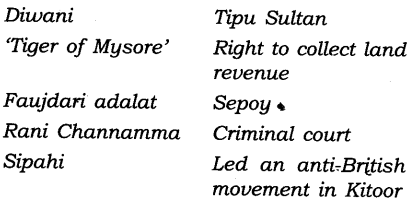
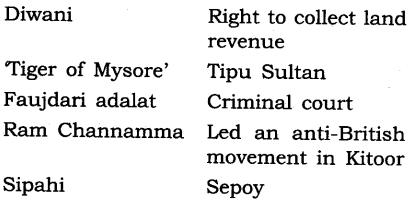
Question 1. Match the following: Answer:
Question 2. Fill in the blanks: (a) The British conquest of Bengal began with the Battle of ………… (b) Haider All and Tipu Sultan were the rulers of ………….. (c) Dalhousie implemented the Doctrine of …………… (d) Maratha kingdoms were located mainly in the part of …………… India. Answer: (a) Plassey (b) Mysore (c) Lapse (d) Western
Question 3. State whether true or false: (a) The Mughal empire became stronger in the eighteenth century. (b) The English East India Company was the only European company that traded with India. (c) Maharaja Ranjit Singh was the ruler of Punjab. (d) The British did not introduce administrative changes in the territories they conquered. Answer: (a) False (b) False (c) True (d) False
Question 4. What attracted European trading companies to India? Answer:- European trading companies were attracted due to the following reasons:
Cheap and fine quality of silk and cotton.
For spices like pepper, cloves, cardamom and cinnamon etc.
Question 5. What were the areas of conflict between the Bengal Nawabs and the East India Company? Answer:- The areas of conflict between the Bengal Nawabs and the East India Company:-
The Bengal nawabs asserted their power and autonomy and refused to grant the Company concessions,
They demanded large tributes for the Company’s right to trade,
They denied the Company any right to mint coins,
They stopped the Company from extending its fortifications
Accusing the Company of deceit, they claimed that the Company was depriving the Bengal government of huge amounts of revenue and undermining the authority of the nawab. It was refusing to pay taxes, writing disrespectful letters, and trying to humiliate the nawab and his officials. These were the areas of conflict between the Bengal Nawabs and the East India Company.
Question 6. How did the assumption of Diwani benefit the East India Company? Answer:- The Mughal emperor, in 1765, appointed the Company’s the Diwan of the provinces of Bengal. The Diwani allowed the Company to exploit the vast revenue resources of Bengal. This solved a major problem that the company had earlier faced. Although its trade had expanded, it had to buy most of the goods in India with gold and silver imported from Britain. The overflow of gold from Britain stopped after the assumption of Diwani. Now revenue from India could finance Company expenses. These revenues they used to purchase cotton and silk textiles in India, maintain Company troops and meet the cost of building the Company fort and offices at Calcutta.
Question 7. Explain the system of ‘subsidiary alliance’. Answer: Subsidiary Alliance System:-
The Britishers as a supreme power: Whichever state wanted to sign this treaty, had to accept the English as a supreme authority. The East India Company behaved as a guardian of that state.
Appointment of resident: The state kept an English Resident in their court, to check the activities of the king.
Keeping of an English army: Indian rulers were not allowed to have their army to protect the state from external and internal invasion. The state had to keep an English army. The state had to bear financial burden of the army.
Giving to the territory: If the Indian rulers failed to make payments, part of their territories were taken away as penalty. e.g.,
The Nawab of Awadh was forced to give over half of his territory to the company in 1801.
Hyderabad was also forced to cede territories on similar grounds.
Protection by the English: In return for the above-mentioned conditions the English Company promised to protect the state from its enemies. They also promised the state not to interfere in the internal affairs of the state but this was a promise they seldom kept.
Question 8. In what way was the administration of the Company different from that of Indian rulers? Answer:- The administration of the Company was different from that of the Indian rulers in the following ways:
The Company divided its administrative units called Presidencies. There were three Presidencies – Bengal, Madras and Bombay. In India, districts were the main administrative units.
Each presidency was ruled by a Governor. Districts were ruled by the Collectors.
The supreme head of the administration of the Company was the Governor-General. But in India, the head of the administration was the king. .
The main job of the Governor-General was to introduce administrative reforms while the main job of the Collector was to collect revenue and taxes- and maintain law and order in his district.
Question 9. Describe the changes that occurred in the composition of the Company’s army. Answer:
East India Company adopted its own method when it began recruitment for the army.
It was known as the sepoy army (from the Indian word sipahi, meaning soldier).
With the change in warfare technology from the 1820s, the cavalry needs of the Company’s army declined, because the British empire was fighting in Burma, Afghanistan, and Egypt. There the soldiers were armed with muskets and matchlocks
The soldiers had to keep pace with changing military requirements.
Its infantry regiments now became more important.
In the early 19th century the British began to develop a uniform military culture.
Soldiers were given European-style training drills and discipline.
They regulated their life far more than before.
Often this created problems since caste and community feelings were ignored in building a force of professional soldiers.
NCERT Solutions For Class 7 History Social Science Chapter 1 Tracing Changes Through A Thousand Years
Question 1. Who was considered a ‘foreigner’ in the past? Answer: The term ‘foreigner’ is used in the sense of a person who is not an Indian. In the medieval period it was applied to any stranger who appeared, say in a given village, someone who was not a part of that society or culture. In this sense a forest-dweller was a foreigner for a city-dweller. But two peasants living in the same village were not foreigners to each other, even though they may have had different religious or caste backgrounds.
Question 2. State whether true or false:
i). We do not find inscriptions for the period after 700.
ii). The Maraihas asserted their political importance during this period.
iii). Forest-dwellers were sometimes pushed out of their lands with the spread of agricultural settlements.
iv). Sultan Ghiyasuddin Balban controlled Assam, Manipur and Kashmir.
Answer: (a) False; (b) False; (c) True; (d) False
Question 3. Fill in the blanks: (a) Archives are places where………….. are kept. (b) …………….was a fourteenth-century chronicler. (c) ……., ……., ………, ……… and ………… were some of the crops introduced into the subcontinent during this period. Answer: (a) Manuscripts (b) Ziyauddin Barani (c) Potatoes, com, chillies, tea, coffee.
Question 4. List some of the technological changes associated with this period. Answer: Some of the technological changes associated with this period are:
Persian wheel in irrigation.
Spinning wheel.
Fire-arms in combat.
Question 5. What were some of the major religious developments during this period? Answer: Some of the major significant religious developments occurred in Hinduism. The worship of new deities, the construction of temples by royalty and growing importance of Brahmanas, the priests, as dominant groups in society were the new changes. Brahmanas’ importance grew due to their knowledge of Sanskrit language. They were patronized by the Emperors. The idea of bhakti emerged among people. The merchants and migrants brought with them the teachings of Quran, the holy book of Muslims.
Question 6. In what ways has the meaning of the term ‘Hindustan’ charged over the centuries? Answer: The meaning of the term ‘Hindustan’ has changed over the centuries in the following manner:
In the thirteenth century Minhaj-i-Siraj used the term ‘Hindustan’. He meant areas of Punjab, Haryana and the lands between Ganga and Yamuna. He used this term in a political sense that were a part of the dominions of the Delhi Sultanate. The term never included South India.
In the sixteenth century poet Babur used the term ‘Hindustan’ to describe the geography, the fauna and the culture of the inhabitants of the subcontinent.
In fourteenth-century poet Amir Khusrau used the term ‘Hind’ in the same sense as Babur did in the sixteenth century.
‘Hindustan’ did not carry the political and national meanings as the term ‘India’ does today.
Question 7. How were the affairs of jatis regulated? Answer: The affairs of jatis were regulated in the following way:
Jatis formed their own rules and regulations.
There was an assembly of elders called jati panchayat.
It enforced the rules and regulations.
Jatis were also directed to follow the rules of the village.
Several villages were governed by a chieftain.
Question 8. What does the term pan-regional empire mean? Answer: The term ‘pan-regional’ was used in the sense of the areas of empires spanning diverge regions. The dynasties like Cholas, Khaljis, Tughluqs, and Mughals extended their empires pan-regional. Though, not all these empires were equally stable or successful. But pan-regional rule altered the character of the regions. Most of the regions across the subcontinent were left with the legacies of the big and small states that had ruled over them. The emergence of many distinct and shared traditions in governance the economy elite cultures and languages were some of the prominent factors that took place as a result of pan-regional rules.
Question 9. What are the difficulties historians face in using manuscripts? Answer: Historians faced a lot of difficulties while using manuscripts because:
There was no printing press in the 13th and 14th centuries. Scribes in those days made manuscripts by hand.
To copy was not an easy exercise. Scribes could not read the handwriting of the other writers.
They were forced to guess. So there were small but significant differences in the copy of the scribed.
These small words or sentences here and there grew over centuries of copying.
The manuscripts of the same text became a great extent different from the original.
Question 10. How do historians divide the past into periods? Do they face any problems in doing so? Answer: Historians divide the past into periods on the basis of continuity. This continuity is further based on:
Coins
Inscriptions
Architecture
Textual records
But they face difficulties in doing so as discontinuity exists.
Textual records increased tremendously.
They gradually displaced other types of available information.
Thousand years of human history (or of any country or region) witnessed a number of changes. After all, the ancient history of India is different from that of the other two periods i.e., the medieval period and modem period. Therefore describing the entire period as one historical unit is not an easy task.
Very Short Answer Type Questions
Question 1. Who was al-Idrisi?
Answer: al-Idrisi was an Arab cartographer.
Question 2. Who is a ‘cartographer’?
Answer: Cartographer is one who draws a map.
Question 3. What difference do you notice in the map drawn by al-Idrisi?
Answer: In the map drawn by al-Idrisi we find a completely different view. Here south India is shown at present North India and Sri Lanka is the island at the top
Question 4. Who used the term Hindustan for the first time and when?
Answer: Minhaj-i Siraj used the term ‘Hindustan’ for the first time in the thirteenth century.
Question 5. What sources do historians use for the study of a particular period of history?[V. Imp.]
Answer :-The historians use sources like coins, inscriptions, architectures, and textual records for the study of a specific period.
Question 6. What do you mean by archives?
Answer: Archives were the places where manuscripts were collected.
Question 7. Who were scribes?
Answer: Scribes were those professionals who used to copy down the manuscripts.
Question 8. How did the scribes copy down the manuscripts?
Answer: Scribes copied down the manuscripts by hand.
Question 9. What changes took place during 700 and 1750? [V. Imp.]
Answer: Many technologies like the Persian wheel in irrigation, the spinning wheel in weaving, and firearms in combat made their appearance. Some new foods and beverages like potatoes, corn, chilies, tea, and coffee also arrived in the subcontinent.
Question 10. What factors contributed to a variety of developments?
Answer: The new technologies and innovations came to the subcontinent with the people who came from other areas and settled here.
Question 11. What were the new groups of people to be prominent at this age? [V. Imp.]
Answer: Rajputs, Marathas, Sikhs, Jats, Ahoms, and Kayasthas were the groups which came to be prominent in this age. They availed most of the opportunities of society.
Question 12. What do you mean by Jati Panchayat?
Answer: Jati Panchayat was the assembly of elders that controlled the conduct of the members of their jati They had their own rules and regulations.
Question 13. Who was the Chief of the village?
Answer: Villages were controlled by a Chieftain. Even the smaller Jati Panchayats were bound to follow the village administration.
Question 14. What was the stretch of Delhi Sultan Ghiyasuddin Balban’s Empire?
Answer: According to a Sanskrit Prashasti Delhi Sultan Ghiyasuddin Balban’s empire was stretched from Bengal (Gauda) in the east to Ghazni (Gajjana) in Afghanistan in the west. It also included all of south India (Dravida).
Question 15. Why did Brahmanas dominate in society during this period? [Imp.]
Answer: Brahmanas were the only class of people who were proficient in the Sanskrit language. This was the reason that made them prominent.
Question 16. Who were the patrons?
Answer: Patrons were a group of rulers and rich class of people who provided protection and livelihood to the Brahmanas, artists, and poets.
Question 17. What was the major development of this age?
Answer: The emergence of the idea of bhakti was the major development of this age.
Question 18. How history was divided by historians during the middle of the nineteenth century?
Answer: The British historians divided the history of India into three periods:-
Hindu
Muslim
British.
Question 19. What was the basis of such division?
Answer: Such division was made on the basis of the religion as the historians did not consider any aspect more prominent other than the developments in religions.
Short Answer Type Questions
Question 1. What difference do you trace out in the region of Hindustan of the thirteenth century and the modem India?
Answer: The term ‘Hindustan’ in the thirteenth century implied the areas of Punjab, Haryana, and the lands between the Ganga and Yamuna. Minhaj-i Siraj used the term in a political sense for lands consisting of a part of the dominions of the Delhi Sultanate. The areas included in this term shifted with the extent of the Sultanate. However, it never included south India.
Question 2. What does time mean for historians? How does it help them? [V. Imp.]
Answer: Time, for historians, doesn’t mean just a passing of hours, days, or years. Instead, it reflects changes in social and economic organization, in the persistence and transformation of ideas and beliefs. In order to study historical developments historians divide the past into large segments. It makes the study convenient. The historians study different aspects of the specific period and then assess the comparative developments their impact on society and their contribution to the future generations.
Question 3. What do you mean by pan-regional rule? What was its impact? [V. Imp.]
Answer: Pan-regional rule applies to the trend of extending the empire to the region beyond one’s own state. With the decline of the Mughal Empire in the eighteenth century, many regional states emerged. Consequently, a chance of sharing different traditions in the realms of governance, economy, elite cultures, and languages was brightened. People knew a lot of new things, manners, etc, without losing their own culture and identity.
Question.4. What was the process of copying the manuscript? What were its drawbacks? [Imp.]
Answer: As there was no printing press during the period between 700 and 1750, Scribes used to copy down the manuscripts which were hand-written. Sometimes it was difficult to recognize the original script. So the Scribes used their own way of interpreting the facts. Consequently, there were differences were found in the copies written by different Scribes. As all the copies were handwritten, it was difficult to recognize which was the original one. It was the drawback of such copying.
Question 5. Trace out the major changes in society during 700 and 1750? What was its main reason? [V. Imp.]
Answer: A number of changes took place in society between 700 and 1750. This period traced the technological appearance of Persian wheel in irrigation, the spinning wheel in weaving and firearms in combat. Potatoes, com, chilies, tea, and coffee were some of the new foods and beverages. These developments came with the arrival of the people who migrated to this land. As a result this period saw various changes in the economic, political, social and cultural life,
Question 6. What was the change in the religion of the time? Trace out major developments? [V. Imp.]
Answer: The period between 700 and 1750 witnessed major changes in religion. It was seen prominently in Hinduism. The worship of new deities, the construction of temples by royalty, and the growing importance of Brahmanas, the priests, as dominant groups in society were some of the major developments.
The idea of bhakti emerged. Merchants and migrants brought the new teachings of the ‘Quran’, the holy book of the Muslims. A class of patrons emerged. They were the rulers who provided shelter and protection to the ulemas—the learned theologians and jurists. Muslims were divided into two groups—Shia and Sunni. Shia Muslims believed in Prophet Muhammad’s authority while the Sunnis accepted the authority of the early leaders—Khalifas.
NCERT Solutions for Class 8 Social Science History Chapter 1 How, When and Where
Question.1.
State whether true or false:
(a) James Mill divided Indian history into three periods – Hindu, Muslim, Christian.
(b) Official documents help us understand what the people of the country think.
(c) The British thought surveys were important for effective administration.
Answer.
(a) False
(b) False
(c) True
Question.2.
What is the problem with the periodisation of Indian history that James Mill offers?
Answer.
James Mill divided Indian history into three periods – Hindu, Muslim and British. This periodisation has its own problem. It is difficult to refer to any period of history as ‘Hindu’ or ‘Muslim’ because a variety of faiths existed simultaneously in these periods. It is also not justified to characterise an age through the religion of the rulers of the time. What it suggests is that the lives and practices of others do not really matter. It is worth-mentioning that even rulers in ancient India did not all share the same faith.
Question 3.
Why did the British preserve official documents?
Answer.
The British preserved documents because of the following reasons:
Any information or proof of any decision can be read/used from the preserved documents.
The preserved documents reveal the progress made by country in the past.
One can study the notes and reports which were prepared in the past.
Their copies may be made and used in modern times.
Documents were helpful in understanding social, economical and history of those times.
Question 4.
How will the information historians get from old newspapers be different from that found in police reports?
Answer.
The information printed in newspaper are usually affected by the views and opinions of the reporters, news editors etc. But what historians find in police reports are usually true and realistic.
Very Short Answer Type Questions
Question 1.
Name the events for which specific dates can be determined.
Answer.
The year a king was crowned, the year he married, the year he had a child, the year he fought a particular battle, the year he died, etc.
Question 2.
What was an important aspect of the histories written by the British historians in India?
Answer.
The rule of each Governor-General was an important aspect.
Question 3.
Who was James Mill?
Answer.
He was a Scottish economist and political philosopher and is known for his book A History of British India.
Question 4.
What was Mill’s opinion about the Asian societies?
Answer.
In Mill’s opinion all Asian societies were at a lower level of civilisation than Europe.
Question 5.
What evil practices, according to James Mill, dominated the Indian social life before the British came to India?
Answer.
According to James Mill, the evil practices that dominated to the Indian social life were religious intolerance, caste taboos and superstitious practices.
Question 6.
How did paintings project Governor- General?
Answer.
Paintings projected Governor-Generals as powerful figures.
Question 7.
Why do many historians refer to modem period as colonial?
Answer.
It is because, under British rule people did not have equality, freedom or liberty—the symbols of modernity.
Question 8.
Mention one important source used by historians in writing about the last 230 years of Indian history.
Answer.
The official records of the British administration.
Question 9.
What is done under census?
Answer.
It records the number of people living all the provinces of India and gathers information on castes, religions and occupation.
Question 10 .
What do official records not tell?
Answer.
Official records do not tell what other people in the country felt, and what lay behind their actions.
Question 11.
Why do we try and divide history into different periods?
Answer.
We do so in order to capture the characteristics of a time, its central features as they appear to us.
LONG TYPE QUESTIONS AND ANSWERS
Question 1.
How did James Mill view India?
Answer.
James Mill did not cherish any positive idea about India. He was of the opinion that all Asian societies were at a lower level of civilisation than Europe. According to his telling of history, before the British came to India, the Hindu and the Muslim despots ruled the country. Religious intolerance, caste taboos and superstitious practices dominated social life. He felt that only British rule could civilise India. He suggested that the British should conquer all the territories of India to ensure the enlightenment and happiness of the Indian people. For India was not capable of progress without the help of the British.
Question 2.
Historians divide Indian history into ancient, medieval and modem. But this division too has its problems. What are these problems?
Answer.
This periodisation has been borrowed from the West where the modem period was associated with the growth of dll the forces of modernity such as science, reason, democracy, liberty and equality. Medieval was a term used to describe a society where these features of modem society did not exist.
It is difficult for us to accept this characterisation of the modem period. Here, it is worth-mentioning that Indians did not have equality, freedom or liberty under the British rule. The country also lacked economic growth and progress in that period. It is therefore many historians refer to modem period as colonial period.
Question 3.
What did the British do to preserve important official documents and letters?
Answer.
The British felt the need to preserve all the important official documents and letters. For this, they set up record rooms attached to all administrative institutions. The village tahsildar’s office, the collectorate, the commissioner’s office, the provincial secretariats, the lawcourts – all had their record rooms. The British also established specialised institutions such as archives and museums to preserve important records.
Question.4.
What do official records not tell? How do we come to know about them?
Answer.
Official records do not always help us understand what other people in the country felt, and what lay behind their actions. For that we have diaries of people, accounts of pilgrims and travellers, autobiographies of important personalities, and popular books, etc. that were sold in the local bazaars. With the spread of printing press, newspapers came to be published and issues began to be debated in public. Leaders and reformers wrote.to spread their ideas, poets and novelists wrote to express their feelings.
Question.5.
How did the British conquer India and establish their rule?
Answer.
The British conquered India in the following ways:
They subjugated local nawabs and rajas.
They established control over the economy and society collected revenue to meet all their expenses, bought goods they wanted at lower prices and produced crops they needed for export.
They brought changes in rulers and tastes, customs and practices.
Thus, they moulded everything in their favour and subjugated the country very soon.
Question. 6.
How do the official records of the British administration help historians to write about the last 250 years of Indian history?
Answer.
The British believed that the act of writing was important. Hence, they got written up every instruction, plan, policy decision, agreement, investigation, etc. They thought that once this was done, things could be properly studied and debated. This conviction produced an administrative culture of mtemos, notings and reports.
The British were very interested in preserving all important documents and letters. For this, they established record rooms attached to all administrative institutions such as the village tahsildar’s office, the collectorate, law courts etc. They also set up archives and museums to preserve important records.
Letters and memos that moved from one branch of the administration to smother in the early years of the 19th century can still be read in the archives. Historians can also take help from the notes and reports that district officials prepared or the instructions and directives that were sent by officials at the top to the provincial administrators.
Question.7.
How did surveys become important under the colonial administration?
Answer.
The British gave much importance to the practice of surveying because they believed that a country had to be properly known before it could be effectively administred. Therefore, they carried out detailed surveys by the early 19 th century in order to map the entire country:
They conducted revenue surveys in villages.
They made efforts to know the topography, the soil quality, the flora, the fauna, the local histories and the cropping pattern.
They also introduced census operations, held at the interval of every ten years from the end of the 19th century. They prepared detailed records of the number of people in all the provinces of India, noting information on castes, religions and occupation separately.
The British also carried on several other surveys such as botanical surveys, zoological surveys, archeolo¬gical surveys, forest surveys, etc. In this way, they gathered all the facts that were essential for administering a country.
NCERT Solutions for Class 6 Social Science (History)Chapter 1 What, Where, How and When?
1. Match the following:
2. List one major difference between manuscripts and inscriptions.
Answer:
3. Make a list of as. the objects that archaeologists may find. Which of these could be made of stone?
Answer: The answer can be summarized through this flow diagram:
The ones that could be made of stone are:-
Surface used for writing inscriptions
Remains of buildings
Objects like tools, weapons, etc.
4. What do you think ordinary men and women did not generally keep records of what they did?
Answer:
We think ordinary men and women did not generally keep records of what they did due to the following reasons:-
They did not know the art of writing in the beginning.
Even some of them were not literate even after the knowledge of the script.
They were not having an interest in such works.
They did not know the importance of keeping records of the events. The lack of historical sense was mainly responsible for it.
5. Describe at least two ways in which you think the lives of kings would have been different from those of farmers.
Answer: The lives of kings would have been different from those of farmers:-
The kings used to live in palaces or big houses. The farmers used to live in huts or in very small houses.
The kings were dependent for their food on farmers. Farmers used to produce food for themselves and other people also.
The kings wore showy and costly clothes and ornaments. Farmers wore simple and very cheap clothes.
6.What were the subjects on which books were written in the past? Which of these would you like to read?
Answers: Before paper was discovered scholars wrote on:
dried leaves,
on the bark of birch trees and
sometimes on copper (or metal) plates and stones.
VERY SHORT TYPE QUESTION & ANSWER
01.What do you know about the location of the Sulaiman and Kirthar hills?
Or
Where are the Sulaiman and Kirthar hills located?
Answer: The Sulaiman and Kirthar hills are located In the modem day Pakistan.
2. Name any two animals which the people of the Sulaiman and Kirthar hills reared.
Answer: Sheep and goat.
3. Where are the Garo hills located?
Answer: The Garo hills are in the north-east of India.
4. What are tributaries? [V. Imp.]
Answer: Tributaries are smaller rivers that flow into a bigger river.
5. Name the tributary of the river Ganga.
Answer: Son.
6. Where was Magadha located?
Answer: Magadha was located in the south of the Ganga.
7. Why was Magadha famous? [V. Imp.]
Answer: Magadha was famous because its mlers were very powerful who established a big kingdom.
8. What was the job of religious teachers? [V. Imp.]
Answer: Religious teachers moved from one place to another to offer instruction and advice to the people who met on the way.
9. From where does the word India come?
Answer: The word India comes from the Indus, known as Sindhu in Sanskrit.
10. What is meant by the manuscript?
Answer: Manuscript is a hand-written matter.
11. What was used in ancient times to write manuscripts?
Answer: Palm leaf or the bark of the birch tree was used in ancient times to write manuscripts.
12. What are inscriptions?
Answer: Inscriptions are writings on relatively hard surfaces like stone or metal.
13. Why do archaeologists look for bones of animals, birds, and fish?
Answer: They do so in order to find out what people ate in the past.
14. What are the occupations of the people of the Andaman Islands?
Answer: The people of the Andaman Islands are engaged in fishing, hunting, and collecting forest produce.
Short Answer Type Questions
1. What do you know about the earliest people who lived along the banks of river Narmada for several hundred thousand years?
Answer: Those people were skilled gatherers. They gathered their food. They also collected roots, fruits and other forest produce for their food. They also hunted animals for this purpose.
2. People in the earliest times used to travel from one place to another. But their journeys were full of dangers. What type of dangers did they face?
Answer: It is true that people in the earliest times used to travel from this place to that. But their journeys were dangerous. The hills, and high mountains including the Himalayas, deserts, rivers and seas created dangers for them. But they never got afraid of them. Instead they overcame them and continued to travel.
3. Who are archaeologist? What do they do? [V. Imp.]
Answer: Archaeologists are persons who study the objects of the past. They study the remains of the buildings made of stone and brick, paintings and sculpture. They also explore and dig the earth in order to find out tools, weapons, pots, pans, ornaments and coins.
4. How are city people different from the people living in the Andaman Islands?
Answer: People living in the Andaman Islands manage their own food by fishing, hunting and collecting forest produce. On the other hand city, people depend on others for supplies of food.
5. How can you say that historians and archaeologists are like detectives? [V. Imp.]
Answer: Historians often use the word source to refer to the information found from manuscripts, inscriptions and archaeology. Once sources are found, learning about the past becomes an adventure, as we reconstruct it bit by bit. So, historians and archaeologists are like detectives who use all these sources like clues to discover the past.
Answer Type Questions
1. How was traveling an important part of the life of the people in the past? [V. Imp.]
Answer:
People in the past were very fond of travelling from one place to another. Although the hills and high mountains like the Himalayas, deserts, rivers, and seas posed great problems, people kept on travelling. They moved in search of livelihood. They had also in their mind to escape from natural disasters such as floods and droughts. Sometimes, men marched in armies and conquered others’ lands.
Merchants travelled with caravans or ships. They carried valuable goods from place to place. There were religious teachers who used to walk from village to village, town to town. They offered instruction and advice to the people who met them on the way. There were also people who travelled because they were adventurous by nature. They enjoyed discovering new and exciting places.
2. What are the different ways to find out about the past? Describe briefly. [Imp.]
Answer:
The different ways to find out about the past are the following:
(i) Manuscripts. These were the hand-written matters. They were usually written on palm leaf or the bark of the birch tree. While many of these manuscripts got destroyed, many have survived in temples and monasteries. These books dealt with all kinds of subjects such as religious beliefs and practices, the lives of kings, medicines, and science. These manuscripts also included epics, poems, plays.
(ii) Inscriptions are writings on relatively hard surfaces such as stone or metal. Sometimes, kings got their orders inscribed in order to make common people aware of them. Some inscriptions kept records of victories in battle.
(iii) Archaeological excavations or evidence. Archaeology means the study of cultures of the past and of periods of history by examining the remains of buildings and objects found in the earth. Archaeologists explore and dig earth to find tools, weapons, pots, pans, ornaments, and coins. These things provide us valuable information about the past.