Thursday, September 14, 2023

India's Role in the Global World

 India's Role in the Global World

Introduction:

India, the world's largest democracy and a vibrant, diverse nation, plays a pivotal role in the global world. With a rich history, a booming economy, and a strategic geographical location, India's influence is felt across various dimensions of the international stage. This essay delves into the multifaceted role that India plays in the global arena.


Economic Powerhouse:

India's economic prowess is undeniable. It boasts one of the world's largest and fastest-growing economies. Its massive market size, driven by a burgeoning middle class and a dynamic services sector, attracts foreign investments. India's Information Technology (IT) and software services industry are globally renowned, contributing significantly to the digital age.

Geopolitical Significance:

Situated in South Asia, India holds a strategic position that has significant geopolitical implications. It shares borders with various countries, including China and Pakistan, making it a key player in regional dynamics. India maintains diplomatic relationships with major powers like the United States, Russia, and the European Union. Its "Look East" policy has also strengthened ties with Southeast Asian nations, further expanding its global reach.

Demographic Dividend:

India's demographic structure, with a large youth population, offers a demographic dividend that the world cannot ignore. This youthful workforce fuels economic growth, innovation, and technological advancements. However, harnessing this demographic dividend is a challenge that India continues to address.

Cultural and Soft Power:

Indian culture has a profound impact worldwide. Bollywood films, Indian cuisine, yoga, and traditional practices like Ayurveda resonate globally. The soft power of India extends through its contributions to literature, art, music, and spirituality. Yoga, for example, has transcended borders and become a global phenomenon, with International Yoga Day celebrated annually on June 21.

Technological Advancements and Space Exploration:

India has made remarkable strides in technology and space exploration. The Indian Space Research Organisation (ISRO) has successfully launched missions to Mars and the Moon, garnering international recognition for its achievements. India is also a growing player in the global tech industry, with Indian tech professionals making significant contributions to innovation worldwide.

Global Challenges and Initiatives:

India actively engages in addressing global challenges. It is a signatory to international agreements like the Paris Agreement on climate change. The country is investing in renewable energy sources and adopting sustainable practices to combat environmental issues. India's efforts in global health, such as vaccine production, have gained prominence, particularly during the COVID-19 pandemic.

Security and Regional Stability:

As a nuclear-armed nation, India's security policies and relationships in South Asia have substantial regional and global implications. Maintaining stability and peace in the region is of paramount importance, and India's actions in this regard affect global security dynamics.

Indian Diaspora:

The Indian diaspora is a vital component of India's global influence. With significant communities in countries around the world, the diaspora contributes to various aspects of host nations' societies, including politics, economics, and culture. It acts as a bridge between India and the world, fostering people-to-people connections and enhancing India's global presence.

Conclusion:

In conclusion, India's role in the global world is multifaceted and ever-evolving. As an economic powerhouse, a strategic player in geopolitics, a source of cultural and soft power, and a pioneer in technology and space exploration, India's influence spans across continents. It actively participates in addressing global challenges while ensuring regional stability. The Indian diaspora adds an extra dimension to its global reach. As India continues to navigate the complexities of the 21st century, its role on the global stage is bound to grow, shaping the world's future in various ways.

Sunday, September 10, 2023

The G20 Summit: Fostering Global Cooperation in the 21st Century

 The G20 Summit: Fostering Global Cooperation in the 21st Century


Introduction

The G20 Summit, comprising leaders from the world's largest economies, represents a critical platform for global economic cooperation and policy coordination. Established in 1999, the G20 has evolved into a forum that addresses a wide range of pressing global issues, from economic stability and trade to climate change and public health. This essay explores the history, significance, key themes, and challenges of the G20 Summit, highlighting its role in fostering cooperation and shaping the global landscape in the 21st century.

Historical Context

The G20, short for the "Group of Twenty," emerged as a response to the Asian financial crisis of the late 1990s. In the wake of this crisis, finance ministers and central bank governors from 20 major economies began meeting to discuss global financial stability. These meetings laid the foundation for the first G20 Summit, held in Berlin in 1999. Since then, the G20 has expanded its agenda and scope, becoming a premier forum for international economic cooperation.

Wednesday, September 6, 2023

Class 8 History Chapter 5 When People Rebel

NCERT Solutions for Class 8 Social Science History Chapter 5 When People Rebel

 Question 1.

What was the demand of Rani Lakshmibai of Jhansi that was refused by the British?

Answer:

To accept her adopted son to succeed the throne of the king, after the death of her husband.


Question 2.

What did the British do to protect the interests of those who converted to Christianity?

Answer:

Those who converted to Christianity would inherit the property of his ancestors.


Question 3.

What objections did the sepoys have to the new cartridges that they were asked to use?

Answer:

Objections the sepoys had to the new cartridges were:

  • The cartridges were greased with the fat of cows and pigs.
  • The sepoys had to use mouth to remove the covering of the cartridges.
  • They termed the cartridges to be a violation of the religious sentiments.
  • Hence, they rebelled.

Question 4.

How did the last Mughal emperor live the last years of his life?

Answer:

The last Mughal emperor lived a very pathetic life during the last years of his life. He was tried in court and sentenced to life imprisonment. He and his wife were sent to prison in Rangoon. He died there after four years.


Question 5.

What could be the reasons for the confidence of the British rulers about their position in India before May 1857?

Answer:

Reasons for the confidence of the British rulers about their position in India before May 1857:-

  • The traditional rulers failed to develop independent leadership.
  • They also failed to have independent social, economic, and political aims of their own.
  • They fought among themselves and could not present a united front against the foreign rule.
  • A section of the people practiced inhuman social practices. They did not rise in revolt against the Britishers.

Question 6.

What impact did Bahadur Shah Zafar’s support to the rebellion have on the people and the ruling families?

Answer:

Bahadur Shah Zafar’s support to the rebellion boosted the morale of the people and the ruling families. They became united to fight the British authority with double spirit.

People of the towns and villages rose up in rebellion and rallied around local leaders, zamindars and chiefs. Nana Saheb, the adopted son of the late Peshwa Baji Rao, who lived near Kanpur, gathered arme^ forces and expelled the British garrison from the city. He proclaimed himself Peshwa.

He declared that he was a Governor under emperor Bahadur Shah Zafar. In Lucknow, Birjis Qadr, the son of the deposed Nawab Wajid Ali Shah, was proclaimed the new Nawab. He too acknowledged the suzerainty of Bahadur Shah Zafar. In Jhansi, Rani Lakshmibai joined the rebel sepoys and fought the British along with Tantia Tope, the general of Nana Saheb.


Question 7.

How did the British succeed in securing the submission of the rebel landowners of Awadh?

Answer:

British succeeded in securing the submissions of the rebel landowners of Awadh:

  • They provided inheritance rights to the landowners (who would enjoy traditional rights over their land).
  • They were exempted from taxes.
  • They were rewarded.
  • They would be safe and their rights and claims would not be denied to them.

Question 8.

In what ways did the British change their policies as a result of the rebellion of 1857?

Answer:

Some important changes brought by the British after the revolt were:

1. According to the Act of 1858 powers of the East India Company were transferred to the British Crown in India.

  • Secretary of State was appointed for governance and Governor-General was given the title of Viceroy.
  • Secretary of State was to be assisted by a council of 15 members. It was only an advisory body.
  • Governor-General was answerable to the Secretary of State.

2. All rulers were made to acknowledge British Queen as Sovereign Paramount and were allowed to pass their kingdoms to their heirs.

  • The proportion of Indian soldiers in the army was reduced. More soldiers were taken from Gurkhas, Sikhs and Pathans.

3. Muslims were seen held responsible for rebellion and their land was confiscated.

4. Social and religious practices were given respect.

  • Zamindars and landlords were given protection and rights over their lands.


Monday, September 4, 2023

Class 8 History Chapter 8 Civilising the “Native”, Educating the Nation

 NCERT Solutions for Class 8 Social Science History Chapter 8 Civilising the “Native”, Educating the Nation

Question 1.
Match the following:


Answer:- 

Question 2.
State whether true or false

  1. James Mill was a severe critic of the Orientalists.
  2. The 1854 Despatch on education was in favour of English being introduced as a medium of higher education in India.
  3. Mahatma Gandhi thought that the promotion of literacy was the most important aim of education.
  4. Rabindranath Tagore felt that children ought to be subjected to strict discipline.
Answer:

  1. True
  2. True
  3. False
  4. False

Question 3.
Why did William Jones feel the need to study Indian history, philosophy and law?
Answer:

  1. William Jones came to represent a particular attitude towards India. He shared a deep respect for ancient cultures, both of India and of the West.
  2. Jones and Colebrooke felt that India had attained its glory in the ancient past. It declined later on. In order to understand India, it was necessary to discover the sacred and legal texts produced in the past.
  3. These texts would reveal the ideas and laws of Hindus and Muslims and would form the basis of future development.
  4. Jones and Colebrooke believed that their project would help the British learn from Indian culture. Indians would also rediscover their own heritage. In this way the British would become guardians and masters of Indian culture.

Question 4.
Why did James Mill and Thomas Macaulay think that European education was essential in India?
Answer:

  1. James Mill was the strongest critic of the Orientalists.
  2. He declared that the British should not teach what the natives wanted, or what they respected, in order to please them and “win a place in their heart”.
  3. The £pm of education should be to teach what was useful and practical.
  4. Indians should be made familiar with the scientific and technical advances that the West had made, and not the sacred literature of the Orient.
  5. Macaulay urged the British government in India to stop wasting public money in promoting Oriental learning, for it had no practical use.
  6. He felt that knowledge of English would allow Indians to read some of the finest literature the world had produced; it would make them aware of the developments in Western science and philosophy.
  7. The teaching of English could thus be a way of civilizing people, changing their tastes, values, and culture.

Question 5.
Why did Mahatma Gandhi want to teach children handicrafts?
Answer:
Mahatma Gandhi wanted to teach children handicraft because of the following reasons:

  1. People would work with their hands.
  2. The craft would develop their minds.
  3. It would also develop their capacities to understand.

Question 6.
Why did Mahatma Gandhi think that English education had enslaved Indians?
Answer:

  1. According to Mahatma Gandhi, colonial education created a sense of inferiority in the minds of Indians. He said it made them see Western civilisation as superior which destroyed the pride they had in their own culture.
  2. He said: It was sinful—it enslaved Indians—it cast an evil spell on them.
  3. Charmed by the West, appreciating everything that came from the West, Indians educated in these institutions admired British rule.
  4. Mahatma Gandhi wanted an education that could help Indians recover their sense of dignity and self-respect.
  5. Mahatma Gandhi -strongly was in favour of Indian languages to be the medium of teaching.
  6. Education in English crippled Indians and distanced them from their own social surroundings. This made them “straneers in their own lands”. Speaking a foreign tongue (language) despised local culture.
  7. Mahatma Gandhi further said that western education focused on reading and writing rather than oral knowledge;
  8. It valued textbooks rather than life experience and practical knowledge.
  9. He said education should develop a person’s mind and soul.
  10. Literacy or simply learning to read and write—by itself did not count as education.
  11. People had to work with their hands and learn a craft. They should know how different things operated.


Class 8 History Chapter 6 Weavers, Iron Smelters and Factory Owners

 Class 8 History Chapter 6 Weavers, Iron Smelters and Factory Owners

Question 1.

What kinds of cloth had a large market in Europe?

Answer:

Chintz (chhint), Cossaes (Khassa) and Bandanna. Bandanna word was derived from the word bandhan . It referred to a variety of brightly coloured cloth, produced through a method of tying and dying.

Question 2.

What is jamdani?

Answer:

Jamdani is a fine muslin on which decorative motifs are woven on the loom, typically in grey and white.

Question 3.

What is bandanna?

Answer:

Bandanna is a brightly coloured and printed scarf for neck and head. This word was derived from the word Bandhan. It referred to a variety of brightly coloured cloth, produced through a method of tying and dying.

Question 4.

Who are the Agarias?

Answer:

Groups of men and women carrying basket-loads of iron are known as the Agarias.

Question 5.

Fill in the blanks:

  1. The word chintz comes from the word ________
  2. Tipu’s sword was made of _____ steel.
  3. India’s textile exports declined in the _____ century

Answer:-

  1. chintz
  2. Wootz
  3. 19th.

Question 6.

How do the names of different textiles tell us about their history?

Answer:

  • European traders first saw fine cotton cloth from India in Mosul in present-day Iraq. They referred to all finely woven textiles as “muslin”.
  • Portuguese first came to India in search of spices and landed in Calicut on the Kerala coast in south-west India. They took back cotton textiles to Europe, along with the spices. They named it “Calico”. Subsequently Calico became the general name for all cotton textiles.
  • Many other words point to the popularity of Indian textiles in Western markets.
  • The pieces included printed cotton cloths called Chintz, (?5fe), Cossaes (or Khassa) and
  • Bandanna is a brightly coloured and printed scarf for the neck or head. This term was derived from the word “Bandanna” (Hindi for tying).
  • Other clothes were known by their place of origin: Kasimbazar, Patna, Calcutta, Orissa and Charpoore.
  • The widespread use of such words shows how popular Indian textiles had become in different parts of the world.

Question 7.

Why did the wool and silk producers in England protest against the import of Indian textiles in the early eighteenth century?

Answer:

Textile industry had just begun to develop in England in the early 18th century. The wool and silk producers in England found themselves unable to compete with Indian textiles. They wanted to secure the market within the country by preventing the entry of Indian textiles. Therefore, they protested against its import.

Question 8.

How did the development of cotton industries in Britain affect textile producers in India?

Answer:

Cotton industries in Britain developed and adversely affected textile producers in India in several ways:

1. Indian textiles faced competition from British textiles in the European and American markets.

2. Export of textiles to England became more and more difficult because the British Govt, imposed very high duties on Indian textiles.

3. In the beginning of the 19th century, cotton textiles made in Britain successfully ousted Indian goods from their traditional markets in Africa, America and Europe.

4. Thousands of weavers in India were now thrown out of employment.

  • Bengal weavers were the worst hit.
  • English and European companies stopped to buy Indian goods. Their agents no longer gave out advances to weavers to secure supplies.
  • Distressed weavers wrote petitions to the government to help them.

5. By the 1830s British cotton cloth flooded Indian markets. Actually by the 1880s, 67% of all the cotton clothes worn by Indians were made of cloth produced in Britain. This affected not only specialist weavers but also spinners.

6. Thousands of rural spinner women were rendered jobless.

Question 9.

Why did the Indian iron smelting industry declined in the nineteenth century?

Answer:

There were several reasons:

  • The new forest laws of the colonial government prevented people from entering the reserved forests. Now it became difficult for the iron smelters to find wood for charcoal. Getting iron ore was also a big problem. Hence, many gave up their craft and looked for other jobs.
  • In some areas the government did grant access to the forest. But the iron smelters had to pay a very high tax to the forest department for every furnace they used. This reduced their income.
  • By the late 19th century iron and steel were being imported from Britain. Ironsmiths in India began using the imported iron to manufacture utensils and implements. This inevitably lowered the demand for iron produced by local smelters.
  • All these reasons caused the decline of the Indian iron smelting industry.

Question 10.

What problems did the Indian textile industry face in the early years of its development?

Answer:

During the early period of its development, the textile industry in India faced many problems.

  • In most countries, governments supported local manufacturers by imposing heavy duties on imports. This finished the competition and protected their infant industries.
  • English producers wanted a secure market within the country by preventing the entry of Indian textiles. British government enacted the Calico Act.
  • The colonial government in India usually refused such protection to local industries.

Question 11.

What helped TISCO expand steel production during the First World War?

Answer:

Before the First World War India imported British steel for rails. When in 1914 the war broke out, steel produced in Britain now had to meet the demands of the war in Europe. So, imports ‘of British steel into India declined and the Indian Railways turned to TISCO for the supply of rails.

As the war dragged on for several years, TISCO had to produce shells and carriage wheels for the war. By 1919 the colonial government was buying 90% of the steel manufactured by TISCO. Over time TISCO became the biggest steel industry within the British empire.


Class 8 History Chapter 4 Tribals, Dikus and the Vision of a Golden Age

 Class 8 History Chapter 4 Tribals, Dikus and the Vision of a Golden Age 

Question 1.

Fill in the blanks:

  1. The British described the tribal people as …………
  2. The method of sowing seeds in jhum cultivation is known as …………….
  3. The tribal chiefs got …………. titles in central India under the British land settlements.
  4. Tribals went to work in the of Assam and the ……………… in Bihar.

Answer:

  1. savage
  2. broadcast
  3. land
  4. tea plantations, coal mines

Question 2.

State whether true or false:

  1. Jhum cultivators plough the land and sow seeds.
  2. Cocoons were bought from the Santhals and sold by the traders at five times the purchase price.
  3. Birsa urged his followers to purify themselves, give up drinking liquor, and stop believing in witchcraft and sorcery.
  4. The British wanted to preserve the tribal way of life.

Answer:

  1. False
  2. True
  3. True
  4. False

Question 3.

What problems did shifting cultivators face under British rule?

Answer:

The life of shifting cultivators was directly connected to the forest. So, when the British brought changes in forest laws, their life was badly affected. The British extended their control over all forests and declared that forests were state property. Some forests were classified as Reserved Forests for they produced timber which the British wanted. In these forests, people were not allowed to move freely and practice jhum cultivations. As a result, many jhum cultivators had to move to other areas in search of work.

Question 4.

How did the powers of tribal chiefs change under colonial rule?

Answer:

Change in the Powers of the Tribal Chiefs under Colonial Rule:-

  • Before the arrival of the British in India, tribal chiefs were important people.
  • They had economic power.
  • They had the right to administer and control their territories.
  • In some areas, they had their own policy.
  • They decided on the local rules of land and forest management.

The British changed their functions and powers considerably.

  • They were allowed to keep their land titles over a cluster of villages and rent outlands.
  • They were divested of their administrative power.
  • They were forced to follow laws made by the British in India.
  • They also had to pay tribute to the British, and discipline the tribal groups
  • on behalf of the British.
  • They lost the authority they had earlier enjoyed amongst their people.
  • Now they were unable to fulfill their traditional functions.

Question 5.

What accounts for the anger of the tribals against the dikus?

Answer:

The tribals wanted to drive out the dikus—missionaries, moneylenders, Hindu landlords, and the government because they saw them as the cause of their misery. The following facts account for their anger against the dikus:

  • The land policies of the British were destroying their traditional land system.
  • Hindu landlords and moneylenders were taking over their land.
  • Missionaries were criticising their traditional culture.

Question 6.

What was Birsa’s vision of a golden age? Why do you think such a vision appealed to the people of the region?

Answer:

Birsa was deeply influenced by many of the ideas he came in touch within his growing-up years. The movement that he led aimed at reforming tribal society. He urged the Munda to give up drinking liquor, clean their village, and stop believing in witchcraft and sorcery. He often remembered the gloden past of the Mundas, when they lived a good life, constructed embankments, tapped natural springs, planted trees and orchards, practiced cultivation to earn their living. They did not kill their brethren and relatives. They lived honestly.

Birsa wanted to restore this glorious past. Such a vision appealed to the people of the region because they were very much eager to lead a free life. They had got fed up with the colonial forest laws and the restrictions that were imposed on them.


Sunday, September 3, 2023

 Class 8 History Chapter 2 From Trade to Territory 


Question 1.

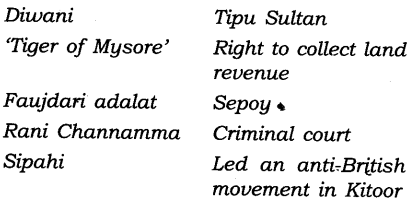
Match the following:


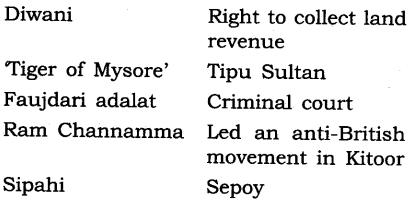
Answer:-


Question 2.

Fill in the blanks:

  1. The British conquest of Bengal began with the Battle of …………
  2. Haider Ali and Tipu Sultan were the rulers of …………..
  3. Dalhousie implemented the Doctrine of ……………
  4. Maratha kingdoms were located mainly in the part of …………… India.

Answer:

  1. Plassey
  2. Mysore
  3. Lapse
  4. Western

Question 3.

State whether true or false:

  1. The Mughal empire became stronger in the eighteenth century.
  2. The English East India Company was the only European company that traded with India.
  3. Maharaja Ranjit Singh was the ruler of Punjab.
  4. The British did not introduce administrative changes in the territories they conquered.

Answer:

  1. False
  2. False
  3. True
  4. False

Question 4.

What attracted European trading companies to India?

Answer:

  • The fine qualities of cotton and silk produced in India.
  • Indian spices such as pepper, cloves, cardamom, and cinnamon.

Question 5.

What were the areas of conflict between the Bengal Nawabs and the East India Company?

Answer:

  • The Bengal nawabs asserted their power and autonomy and refused to grant the Company concessions,
  • They demanded large tributes for the Company’s right to trade,
  • They denied the Company any right to mint coins,
  • They stopped the Company from extending its fortifications
  • Accusing the Company of deceit, they claimed that the Company was depriving the Bengal government of huge amounts of revenue and undermining the authority of the nawab. It was refusing to pay taxes, writing disrespectful letters, and trying to humiliate the nawab and his officials. These were the areas of conflict between the Bengal Nawabs and the East India Company.

Question 6.

How did the assumption of Diwani benefit the East India Company?

Answer:

The Mughal emperor, in 1765, appointed the Company’s the Diwan of the provinces of Bengal. The Diwani allowed the Company to exploit the vast revenue resources of Bengal. This solved a major problem that the company had earlier faced. Although its trade had expanded, it had to buy most of the goods in India with gold and silver imported from Britain. The overflow of gold from Britain stopped after the assumption of Diwani. Now revenue from India could finance Company expenses. These revenues they used to purchase cotton and silk textiles in India, maintain Company troops and meet the cost of building the Company fort and offices at Calcutta.

Question 7.

Explain the system of ‘subsidiary alliance’.

Answer:

Under the system of ‘subsidiary alliance’, Indian rulers were not allowed to have their independent armed forces. They were to be protected by the Company, but had to pay for the ‘subsidiary forces’ that the Company was supposed to maintain for the purpose of this protection. If the Indian rulers failed to make the payment, the part of their territory was taken away as penalty. The states which had to lose their territories on this ground were Awadh and Hyderabad.


Class 8 Chapter 2 Understanding Secularism

 Class 8 Chapter 2 Understanding Secularism

Question 1.

What examples does history provide us on the grounds of religion?

Answer:

History provides us with several examples of discrimination, exclusion, and persecution on the grounds of religion.

Question 2.

What happened in the Jewish state of Israel?

Answer:

Muslim and Christian minorities were treated badly in the Jewish state of Israel.

Question 3.

How are non-Muslims treated in Saudi Arabia?

Answer:

In Saudi Arabia, non-Muslims are not allowed to build a temple, church etc. They also cannot gather in a public place for prayers.

Question 4.

What does the term ‘secularism’ refer to?

Answer:

The term ‘secularism’ refers to the separation of the power of religion from the power of the State.

Question 5.

What do you mean by the freedom to interpret’?

Answer:

‘Freedom to interpret’ means an individual’s liberty to develop his own understanding and meaning of the religion that one practices.

Question 6.

Why cannot government schools celebrate religious festivals?

Answer:

Government schools cannot celebrate religious festivals because it will be a violation of the government’s policy of treating all religions equally.

Question 7.

Why is Paramjit allowed to drive in pagri?

Answer:

Paramjit is a Sikh youth and for him wearing a pagri is a very important part of his religion.

Question 8.

How is Indian secularism different from that of American secularism?

Answer:

Unlike Indian secularism, there is a strict separation between religion and the State in American secularism.

Question 9.

What is meant by ‘principled distance’?

Answer:

This means that any interference in religion by the State has to be based on the ideals laid out in the Constitution.

Question 10.

What are the three objectives of a secular State?

Answer:

The three objectives of a secular State are:

  • One religious community does not dominate another.
  • Some members do not dominate other members of the same religious community.
  • The State does not enforce any particular religion nor does it take away the religious freedom of individuals.

Class 8 Chapter 4 Agriculture

Class 8 Geography Chapter 4 Agriculture Ncert Textbook Questions Solved

Question 1.

Answer the following questions.

(i) What is agriculture?

(ii) Name the factors influencing agriculture.

(iii) What is shifting cultivation? What are its disadvantages?

(iv) What is plantation agriculture?

(v) Name the fibre crops and name the climatic conditions required for their growth.

Answer:

(i) Agriculture is the primary activity that involves the cultivation of crops, fruits, vegetables, flowers and rearing of livestock.

(ii) Factors influencing agriculture include the topography of soil and climate. 

(iii) Shifting cultivation is the type of farming in which agricultural activities are shifted from one field to another when the fertility of the soil of the former is diminished

Disadvantages:

  • Deforestation
  • Soil erosion
  • Small patches for cultivation
  • Not sufficient for feeding a large population.

(iv) Plantation agriculture is a type of commercial farming where only a single crop (like tea, coffee, sugarcane, cashew, rubber, banana or cotton) is grown. A large amount of labour and capital are required. The product is processed on the farm itself or nearby factories.

(v) Two major fiber crops are jute and cotton. Jute grows well on alluvial soil and requires high temperature, heavy rainfall, and a humid climate for its growth. Cotton needs high temperatures, light rainfall, and bright sunshine for its proper growth.

Question 2.

Tick the correct Answer:

(i) Horticulture means

(a) growing of fruits and vegetables

(b) primitive farming

(c) growing of wheat

(ii) Golden fiber refers to

(a) tea

(b) cotton

(c) jute

(iii) Leading producers of coffee

(a) Brazil

(b) India

(c) Russiac

Answer:

(i) (a), (ii) (c), (iii) (a).


Question 3.

Give reasons.

(i) In India agriculture is a primary activity.

(ii) Different crops are grown in different regions.

Answer:

(i) Agriculture is an activity of growing crops, fruits, vegetables, flowers, and rearing of livestock. It is a primary activity since it directly involves natural resources. In India, a huge number of people derive the activity from their ancestors. Due to lack of literacy in general, farmers prefer agriculture since they acquire the required skills from their ancestors, and so feel comfortable with it.


(ii)

  • Different topography
  • Different soils
  • Different climates
  • Different lifestyles of the people in different regions.

Question 4.

Distinguish between the following.

(i) Primary activities and secondary activities.

(ii) Subsistence farming and intensive farming.

Answer:

(I)


Friday, September 1, 2023

Class 6th Civics Chapter 2 Diversity and Discrimination

NCERT Solutions for Class 6th Social Science Civics Chapter 2 Diversity and Discrimination

01. How can the stereotype that girls are a burden on their parents affects the life of a daughter? Imagine this situation and list at least Jive different effects that this stereotype can have on the way daughters get treated in the house.

Ans:

The Stereotype that girls are a burden on their parents affect the life of a daughter in the following ways:

  • They are not properly cared for.
  • They are not given preference for higher education.
  • They are not allowed to attend/join schools.
  • They are married early.
  • They are not provided nourishing food.
  • They are engaged early in household works/chores.

2. What does the Constitution say with regard to equality? Why do you think it is important for all people to be equal?

Ans: Our Constitution provides that the state shall not discriminate against any citizen on the basis of religion, race, caste, sex, or region. It is important for all people to be equal because only then our society would develop in the true sense of the term. It is our right to be treated equally. It is our right to be given due respect. It is our right to be given equal opportunities. In absence of all these, our life would be hell. Our personality would be suppressed. Hence, we need equality so that we may go ahead without any hindrances. We may prove ourselves helpful in the development of the society and country.

3. How do parents often console boys when they fall and hurt themselves?

Ans. Parents say, “Boys are brave, they don’t cry”. ‘

4. Mention one drawback of stereotypes. [Imp.]

Ans: Stereotypes prevent us from doing certain things that we might otherwise be good at.

5. ‘Some people may experience both kinds of discrimination. ’ What do you mean by ‘both kinds of discrimination’? . [V. Imp.]

Ans: Some people are poor and they belong to groups whose culture is not valued.

6. Mention some activities which are considered less valued.

Ans: Activities like cleaning, washing, cutting hair, picking garbage are considered less valued.

7. Who was Bhim Rao Ambedkar?

Ans: He was a noted Dalit leader. He himself was a Dalit and fought for the rights of the Dalits.

8. What is it that can unite all Indians? [V. Imp.]

Ans: It is equality of all persons that can unite all Indians.

9. What responsibility has been placed on the government by the Constitution?

Ans: It is the responsibility of the government to take specific steps to realise the right to equality for poor and other marginal communities.

10. ‘India is a secular country’. What does this mean?

Ans: This means that people of different religions and faiths have the freedom to practise and follow their religion without any fear of discrimination.


Class 6th civics Chapter 1 Understanding Diversity

 NCERT Solutions for Class 6th Social Science Civics Chapter 1 Understanding Diversity

1. Draw up a list of the different festivals celebrated in your locality. Which of these celebrations are shared by members of different regional and religious communities?

Ans: Festivals shared by different regional and religious communities are:

  • Independence Day
  • Republic Day
  • Gandhi Jayanti

These are our national festivals, so every Indian celebrates them irrespective of region and religion.

2.What do you think living in India with its rich heritage of diversity adds to your life?

Ans: Yes, living in India with its rich heritage of diversity adds to our life in the following ways:

  • We know different people, their culture, customs, traditions, backgrounds. These diverse things add to our life.
  • Geographical diversities decide our way of life, our food, our occupations and many other things.
  • We relish our customs and traditions.

3. Do you think the term “unity in diversity” is an appropriate term to describe India? What do you think Nehru is trying to say about Indian unity in the sentence quoted above from his book “The Discovery of India”?

Ans:

Yes, we think that the term ‘unity in diversity’ is an appropriate term to describe India.

Diversities:

  • Geographical diversities like different physical features, climates, vegetations, rivers and lakes.
  • Cultural diversities like different languages, religions, communities, customs, traditions, festivals, rituals, etc.
  • Despite all these diversities there is unity among the people.
  • They are one.
  • They stood against the British and threw the mighty empire by adopting Ahimsa and peaceful means.
  • All the people belonging to various regions are one when the country’s interests are involved.
  • In natural disasters they whole-heartedly contribute for mitigating the sufferings of the people.


Class 6th History Chapter 5 Kingdoms, Kings and an Early Republic

 NCERT Solutions for Class 6th Social Science History Chapter 5 Kingdoms, Kings and an Early Republic

1. State whether true or false:

  • ‘Rajas’ who let the ‘ashvamedha’ horse pass through their lands were irwited to the sacrifice.
  • The charioteer sprinkled sacred water on the king.
  • Archaeologists have found palaces in the settlements of the ‘janapadas’.
  • Pots to store grain were made out of Painted Grey Ware.
  • Many cities in ‘mahajanapadas’ were fortified.

Answer.

  • True
  • False
  • False
  • True
  • False.

2.Fill in the chart given below with the terms: hunter-gatherers, farmers, traders, crafts-persons, herders. ‘


Ans:
Hunter-gatherers, farmers, traders, crafts-persons and herders—all paid taxes.

  • Farmers—one-sixth of the produce.
  • Crafts-persons—in the form of labour.
  • Herders—in the form of animals and animal products.
  • Traders—taxes on goods brought and sold.
  • Hunter-gatherers—forest produce.
3. Who were the groups who could not participate in the assemblies of the ‘ganas’?
Ans: These groups of people were not allowed to participate in the assemblies of the ‘ganas’.

  • Women
  • ‘Dasas’
  • ‘Kammakaras’.
4.Why did the ‘rajas’ of ‘mahajanapadas’ build forts?
Ans:
The rajas of mahajanapadas built forts to protect their capital city.
This means that huge walls of wood, brick or stone were built around them. Forts were probably built because people were afraid of attacks from other kings and needed protection.
It is also likely that some rulers wanted to show how rich and powerful they were by building really large, tall and impressive walls around their cities. Also in this way, the land and the people living inside the fortified areas could be controlled more easily by the king.
5. In what ways are present-day elections different from the ways in which rulers were chosen in ‘janapadas’?
Ans:
Present day elections are conducted by election commission. In janapadas we did not have election commission. Some of the rajas were probably chosen by the jana, the people. But around 3,000 years ago, we find some changes taking place in the ways in which rajas were chosen. Some men now became recognised as rajas by performing very big sacrifices.
In present-day elections, all citizens (including women and dasas etc.) participate in election process after 18 years of their age. But in janapadas all free men over the age of 30 were recognized as full citizens. In janapadas women and slaves were not considered equal free citizens.
Appointments for rulers were made through lottery. All those who wanted to be chosen gave in their names and then some were selected through lottery.


Class 6th History Chapter 4 What Books and Burials Tell Us

 NCERT Solutions for Class 6th Social Science History Chapter 4 What Books and Burials Tell Us

 1. Match the columns: 


Answer:-


02. Megalith Complete the sentences:

  1. Slaves were used for…………….
  2. Megaliths are found in……………
  3. Stone circles or boulders on the surface were used to………………..
  4. Port-holes were used for……………
  5. People at Inamgaon ate…………….
Answer:

1. Work
2. South India, north-east and Kashmir
3. indicate the exact place of burial
4. burying the other member of the same family at the same place
5. wheat, barley, rice, pulses, millets, peas, sesame, etc.

3. In what ways are the books we read today different from the Rigveda?
Ans: The books we read today are written and printed. The Rigveda was recited and heard rather than read. For many years from generation to generation, the process continued. It was written down several centuries after it was first composed and printed less than 200 years ago.

4. What kind of evidence from burials do archaeologists use to find out whether there were social differences amongst those who were buried?
Ans:
Sometimes, archaeologists find a circle of stone boulders or a single large stone standing on the ground. These are the only indications that there are burials beneath.
All these burials have some common features. Generally, the dead were buried with distinctive pots, which are called Black and Red Ware. Also found are tools and weapons of iron and sometimes, skeleton of horses, horse equipment and ornaments of stone and gold.

Several kinds of evidences from burials do archaeologists use to find out that there were social differences amongst those who were buried underneath the megaliths. They think that objects found with a skeleton probably belonged to the dead person. Sometimes more objects were found in one grave than in another. For instance in Brahmagiri, one skeleton was buried with 33 gold beads, 2 stone beads, 4 copper bangles and one conch shell. Other skeletons had only a few pots. Perhaps there were differences in status amongst the people who were buried. Perhaps some were rich, others poor, some chiefs, others followers.

5. In what ways do you think that the life of a ‘raja’ was different from that of a ‘dasa’ or ‘dasi’?
Ans: In the society, ‘raja’ was one of the highest civil positions. ‘Rajas’ were the kings of the community, whereas the ‘dasas’/’dasis’ were the lowest position in society. The ‘dasas’/’dasis’ were slaves who were used for work. They were treated as the property of their owners. They were captured in war.

Class 6 History Chapter 3 In the Earliest Cities

 NCERT Solutions for Class 6 Social Science History Chapter 3 In the Earliest Cities

1. How do archaeologists know that cloth was used in the Harappan civilization?

Answer:

  • According to archaeologists cotton was probably grown in Mehrgarh about 7,000 years ago.
  • Actual pieces of cloth were found attached to the lid of a silver vase and some copper objects at Mohenjodaro.
  • Archaeologists have also found spindle whorls, made of terracotta and faience. These were used to spin thread.
  • We also have indirect evidence to show how cloth was decorated. For example, a stone statue of an important man found at Mohenjodaro shows him wearing an embroidered garment.

2. Match the columns:

Answer:


3. Why were metals, writing, the wheel and the plough important for the Harappans?

Answer: 

Metals: The Harappan made copper tools. They also made ornaments of gold and silver.

Writing: Writing was very important for the Harappans. There were scribes, people who knew how to write. Scribes helped prepare the seals and perhaps wrote on other materials that have not survived.

Wheel: The Harappans used the wheel in carts. They also used the wheel in spinning. The wheel was used by potters to make or shape pots and other things.

Plough: Plough was used to prepare the land for farming by the Harappans.

Saturday, August 26, 2023

Class 6th History Chapter 2 On The Trial of the Earliest People

 NCERT Solutions for Class 6th Social Science History Chapter 2 On The Trial of the Earliest People

1. Complete the sentences:

  • Hunter-gatherers chose to live in caves and rock shelters because
  • Grasslands developed around……….. years ago.
  • Early people painted on the……… of caves.
  • In Hunsgi, tools were made of……….

Answer:

  • they wanted to protect themselves from wild animals and bad weather.
  • 12,000
  • walls
  • limestone

02. Why did the hunter-gatherers travel from place to place? In what ways are these similar to/different from the reasons for which we travel today?

Answer: Hunter-gatherers travelled from place to place for four basic reasons which are as follows: 

  1. If they stayed at one place for a long time, they would have eaten up all the available plant and animal resources. Therefore, they went to another place for more food.
  2. Animals move from place to place. Humans followed them as they hunted them.
  3. Plants and trees bear fruit in different seasons. So when season changed, people moved to another place.
  4. In search of water, people travelled from place to place. Water is necessary for survival.
  5. However, nowadays we travel for different purposes, like:

  • Education:- We travel to schools.
  • Work:- We travel to work.
  • Business:- People travel from place to place for business purposes.
  • Entertainment:- We travel from one place to another to amuse and entertain ourselves, like going to a circus, a zoo or sightseeing.

3. What tools would you use today for cutting fruit? What would they be made of?

Answer: Today, for cutting fruit, we would use modem tools like knives, which are made of iron or steel.

4. List three ways in which hunter-gatherers used fire. Would you use fire for any of these purposes today? ,

Answer: 

(a)

  • Hunter-gatherers used fire as a source of light.
  • They used fire to cook meat or food.
  • They used fire to scare away animals also.
  • Fire keeps him or her warm.

(b) Yes, fire is used as a source to cook food including meat. We also use it to keep us warm. Some people use it for religious purposes and bum their dead bodies.

5. Make two columns in your notebook. In the left hand column, list the foods hunter-gatherers ate. In the right hand column, list some of the foods you eat. Do you notice any similarities/differences.

Answer: 


Differences between the two eating habits: Today, we largely eat processed and cooked food, whereas the early people did not cook their food. They ate everything raw.

Tuesday, August 22, 2023

Class 8 Civics Chapter 1 The Indian Constitution

 NCERT Solutions for Class 8 Social Science Civics Chapter 1 The Indian Constitution


Question 1.

Why does a democratic country need a Constitution?

Solution:

A democratic country needs a constitution because:-


  • In a democracy people choose their representatives and the leaders might misuse their powers. Constitution provides safeguards against this.
  • In a democracy, the constitution ensures that the dominant group does not use power against less powerful groups.
  • The constitution guarantees fundamental rights to the citizens for their social, economic, and political welfare.

Question 2.

What is the difference in who exercises Executive Power in the 1990 and Interim Constitutions of Nepal? Keeping this in mind, why do you think Nepal needs a new Constitution today?

Solution:

In the 1990 Nepal constitution, the Executive powers of the Kingdom were entirely in the hands of the King. According to the Interim constitution drafted in 2007, the executive powers of Nepal are in the hands of the council of ministers headed by the Prime Minister.

There was a dire need for a new constitution as the ideals of the people had changed as the country had moved from a monarchy to a democracy. The old constitution was drafted when the country was under the rule of the king. The people of Nepal fought for a democratic government for many years. So the old constitution does not reflect the ideals of the people. The new constitution will change the rules of the old constitution in order to bring in a new society with new ideas.


Question 3.

What would happen if there were no restrictions on the power of elected representatives?

Solution:

If there were no restrictions on the power of elected representatives then:


  • These leaders (representatives) might misuse their authority.
  • This misuse of authority can result in gross injustice and mismanagement.

Class 7 Civics Chapter 4 Growing up as Boys and Girls

NCERT Solutions For Class 7 Civics Social Science Chapter 4 Growing up as Boys and Girls

 1. What was a very important activity on the Samoan islands in the 1920s?

Answer: Fishing was a very important activity on the Samoan Islands in the 1920s.

 2. How was the girls’ school in Madhya Pradesh in the 1960s designed differently from the boys’ school?

Answer: Girls’ school had a central courtyard where girls played in total seclusion and safety from the outside world. The boys school had no such courtyard.

3. As these girls walked on the streets, they looked so purposeful’. What does the word ‘purposeful’ refer to?

Answer: Their only intention was to get home safe and as soon as possible.

4. Why do we give boys and girls different toys to play with? [V. Imp.]

Answer: We want to tell them that they will have different futures when they become men and women.

5. What do we teach boys and girls in their early childhood? [Imp.]

Answer: We teach boys that they need to be tough and masculine. On the contrary, we, teach girls that they need to be soft and mild.

6. Why did Harmeet develop a notion that her mother did not work?

Answer: In our societies, the work that women do within the home is not recognised as work. It is assumed that this is something that comes naturally to women. It is therefore, Harmeet developed such notions and said that her mother did not work

7. Why are the wages of domestic workers usually low? [V. Imp.]

Answer: It is because the work that domestic workers do, does not have much value.

8. What is the daily schedule of a domestic worker?

Answer: A domestic worker’s day usually begins at five in the morning and ends at twelve in the night.

9. How are domestic workers treated by their employers? [V. Imp.]

Answer: Domestic workers are often not treated well by their employers. Despite the hard work they do, their employers often do not show them much respect.

10. What do you mean by the term ‘double burden’? [Imp.]

Answer: Several women today work both inside and outside the home. This is often referred to as ‘double burden’.

11. Housework commonly involves many different tasks. Name some of them.

Answer: Washing clothes, cleaning, sweeping, cooking, etc.

12. Why do girls like to go to school together in groups?

Answer: Girls like to go to school together in groups because in a group they feel secured.

Class 7 Civics Chapter 1 On Equality

NCERT Solutions For Class 7 Civics Social Science Chapter 1 

On Equality

1. In a democracy why is Universal Adult Franchise important?
Answer: In a democracy, the Universal Adult Franchise is important because of the following reasons:

  1. Democracy is the government of the people, by the people, and for the people.
  2. Every adult irrespective of caste, creed, religion, region, sex, the rich or poor background is allowed to vote. This is called a universal adult franchise.
  3. The concept of the universal adult franchise is based on equality.
  4. In a democracy every citizen is equal.

2. Re-read the box on Article 15 and state two ways in which this Article addresses inequality?
Answer: This Article addresses inequality in terms of access to shops, public restaurants, hotels and places of public entertainment, or [b] the use of wells, tanks, bathing ghats, roads and places of public resort maintained wholly or partly out of state funds or dedicated to the use of the general public.

3. In what ways was Omprakash Valmikis experience similar to that of the Ansaris?
Answer: Omprakash Valmiki’s experience was similar to that of Ansaris in the following ways:

  1. Omprakash Valmiki was not allowed to sit with other students on the desks or mats.
  2. Ansaris were not given apartments on rent in the locality of the people belonging to the Hindu religion.
  3. Omprakash Valmiki was discriminated against on the basis of caste while Ansaris were discriminated against on the basis of religion.

4. What do you understand by the term “all persons are equal before the law”? Why do you think it is important in a democracy?
Answer:

  1. By the term, “all persons are equal before the law”, we understand equality.
  2. Equality is important in a democracy because democracy is the government of the people, by the people and for the people.
    • Equality is the essence of democracy.
    • If people are discriminated against on the basis of caste, creed, religion, sex, prosperity etc. the democracy will not survive.
6. Who have been employed to cook the meal under midday meal scheme?
Answer: Dalit women have been employed for this purpose.

7. How did B.R. Ambedkar view self-respect?
Answer: B.R. Ambedkar viewed self-respect as the most vital factor in life, without which man was cipher.

8. What was the condition of the African-Americans in the United States of America prior to 1950s? [V. Imp.]
Answer: Prior to 1950’s, the African-Americans were treated extremely unequally in the USA and denied equality through law.

9. What is known as the Civil Rights Movements? [V. Imp.]
Answer: A movement took place in the USA in the late 1950’s to push for equal rights for African-Americans. This movement later came to be known as Civil Rights Movement.

Class 7 History Chapter 4 The Mughal Empire

 NCERT Solutions For Class 7 History Social Science Chapter 4 The Mughal Empire

1. Match the following:

  1. mansab – Marwar
  2. Mongol – governor
  3. Sisodiya Rajput – Uzbeg
  4. Rathor Rajput – Mewar
  5. Nur Jahan – rank
  6. subadar – Jahangir
  • Answer: 
  1. mansab – rank
  2. Mongol – Uzbeg
  3. Sisodiya Rajput – Mewar
  4. Rathor Rajput – Marwar
  5. Nur Jahan – Jahangir
  6. subadar – governor


2. Fill in the blanks:

  1. The capital of Mirza Hakim, Akbar’s half-bro: her, was …………………
  2. The five Deccan Sultanate were Berar, Khandesh, Ahmadnagar,
  3. If zat determined a mansabdar’s rank and salary, sewer indicated his………………………
  4. Abul Faze, Akbar’s friend and counsellor, helped him frame the idea of …………. so that he could govern a society composed of many religions, cultures, and castes.

Answer:

  1. Kabul
  2. Bijapur, Golconda
  3. number of horses maintained
  4. administration

3. What were the central provinces under the control of the Mughals?

Answer: Panipat, Lahore, Delhi, Agra, Mathura, Amber, Ajmer, Fatehpur Sikri, Chittor, Ranthambhore and Allahabad.


4. What were the relationships between the mansabdar and the jagir?

Answer:

Relationship between the mansabdar and the jagir:

  • Mansabdars were those who joined Mughal service.
  • Jagirs were the salaries of the mansabdars in the form of revenue assignments.
  • It means mansabdars received jagirs as their salaries. Hence, mansabdars depended upon jagirs for their livelihood.

5. What was the role of the zamindar in Mughal administration?

Answer: Zamtndars were powerful local chieftains appointed by the Mughal rulers. They exercised great influence and power. They collected taxes from the peasants and gave them to the Mughal emperor. Thus, they played the role of intermediaries. In some areas the zamindars became more powerful. The exploitation by Mughal administrators made them to rebellion. They got support from the peasants in rebelling against the Mughal authority.


6. How were the debates with religious scholars important in the formation of Akbar’s ideas on governance?

Answer:

In the 1570’s at Fatehpur Sikri Akbar started discussions on religion with people of different faiths. There were ulemas, Brahmanas, Jesuit Catholic priests and Zoroastrians.

  • These discussions took place in Ibadat Khana. These were about social and religious customs.
  • These interactions made him realise that religious scholars are bigots. They emphasize rituals and dogma.
  • Their teachings create divisions in society. This led to the idea of Sulh-i-Kul or ‘Universal peace’.

7. Why did the Mughals emphasise their Timurid and not their Mongol descent?

Answer: The Mughals were descendants of two great lineages of rulers. From their mother’s side they were descendants of Genghis Khan, ruler of the Mongol tribes. From their father’s side they were the successors of Timur, the ruler of Iran, Iraq and modern-day Turkey. However, the Mughals did not like to be called Mongol because Mongol’s especially Genghis Khan’s, memory was associated with the massacre of innumerable people. It was also linked with the Uzbegs, their Mongol competitors. On the other hand, the Mughals were proud of their Timurid ancestry, because it achieved good name in the history.


8. How important was the income from land revenue to the stability of the Mughal Empire?

Answer:

The income from land revenue is very important to the stability of the Mughal Empire as:

  • It was used for extension of empire, wars, etc.
  • Income is used to pay salaries/wages to army, bureaucrats, artisans and workers.
  • The administrative expenditure is dealt by this income.

9. Why was it important for the Mughals to recruit mansabdars from diverse backgrounds and not just Turanis and Iranis?

Answer: The Mughal Empire expanded to different regions. Hence, it was important for the Mughals to recruit diverse bodies of people in order to make people comfortable with them. Apart from Turanis and Iranis, now there were mansabdars from Indian Muslims, Afghans, Rajputs, Marathas and other groups.

10. Like the Mughal Empire, India today is also made up of many social and cultural units. Does this pose a challenge to national integration?

Answer:

No, this does not pose a challenge to national integration because:

  • We have a unified system of government that has the same rules and regulations for all the citizens irrespective of religion, region, etc.
  • We have a constitution guarding the rights of all and specifying their duties.
  • Now we are unified as a nation, not as distinct states or regions of different rulers.

Class 7 History Chapter 3 The Delhi Sultans

 NCERT Solutions For Class 7 History Social Science Chapter 3 The Delhi Sultans

1. Which ruler first established his or her capital at Delhi?

Answer: The Tomara Rajputs were the first rulers who established their capital at Delhi.

2. What was the language of administration under the Delhi Sultans?

Answer: It was Persian.

3. In whose reign did the Sultanate reach its farthest extent?

Answer: The Sultanate reached its farthest extent during the reign of Muhammad Tughluq.

4. From which country did Ibn Battuta travel to India?

Answer: Ibn Battuta belonged to Morocco, Africa and travelled to India.

5. According to the ‘circle of justice’ why was it important for military commanders to keep the interests of the peasantry in mind?

Answer:

According to the ‘circle of justice’ it was important for military commanders to keep the interest of peasantry in mind. As is clear from the following:

  • A king survived on soldiers.
  • Soldiers worked for salaries.
  • Salaries came from revenue collected from peasants.
  • Peasant would pay revenue when they are prosperous and happy. This in turn will happen when there is justice and honest governance.

6. What is meant by the ‘internal’ and ‘external’ frontiers of the Sultanate?

Answer: The ‘internal’ frontier means the hinterland of the garrison town.

The ‘external’ frontier means the areas beyond the hinterland of the garrison towns.

7. What were the steps taken to ensure that muqtis performed their duties? Why do you think they may have wanted to defy the orders of the Sultans?

Answer:

Steps taken to ensure that the muqtis performed their duties well:

  • Appointment of accountants to check the amount collected by the muqtis.
  • Collection of revenues only which were prescribed by the state, not more than that in any circumstances.
  • Fixation of limit to keep the required number of soldiers.
  • They might be shifted to another area.
  • The muqtis may have wanted to defy the orders of the Sultans because restrictions imposed on them were very rigorous.
  • Their appointment was temporary.

8. What was the impact of the Mongol invasions on the Delhi Sultanate?Ans. The Delhi Sultanate mobilised a large standing army in Delhi. It posed a big administrative challenge.

Answer:

Alauddin Khalji constructed a new garrison town at Siri for his soldiers. He imposed taxes on land to feed the army at the rate of 50 percent of peasant’s yield. He began to pay the soldiers in cash.

Muhammad Tughluq shifted people of Delhi to Daulatabad in south and thus converted Delhi into a garrison town. He also disbanded the army. He also paid the soldiers in cash.

Thursday, August 17, 2023

Class 7 History Chapter 2 New Kings And Kingdoms

 NCERT Solutions For Class 7 History Social Science Chapter 2 New Kings And Kingdoms

1. Match the following:
Gwjara-Pratiharas    –      Western Deccan
Rashtrakutas             –       Bengal
Palos                           –     Gujarat and Rajasthan
Cholas                         –        Tamil Nadu
Answer: 
Gurj ara-Pratiharas        –   Gujarat and Rajasthan
Rashtrakutas                   –   Western Deccan
Palas                                 –    Bengal
Cholas                               –   Tamil Nadu

2. Who were the parties involved in the ‘tripartite struggle’?
Answer: The parties involved in the tripartite struggle were Gurjar-Pratihara, Rashtrakuta, and Pala dynasties.

3. What were the qualifications necessary to become a member of a committee of the sabha in the Chola Empire?
Answer:
The working of a sabha according to the Uttaramerur inscription is given below:

  1.  All those who wish to become members of the sabha should be owners of the land from which land, revenue is collected.
  2. They should have their own homes.
  3. They should be between 35 and 70 years of age.
  4. They should have knowledge of the Vedas.
  5. They should be well-versed in administrative matters and honest in all dealings.
  6. If anyone has been a member of any committee in the last three years, he cannot become a member of another committee.
  7. Anyone who has not submitted his accounts, as well as those of his relatives, cannot contest the elections.

4. What were the two major cities under the control of the Chahamanas?
Answer:  
Delhi and Ajmer were the two cities under control of the Chahamanas.

5. How did the Rashtrakutas become powerful?
Answer:
Rashtrakutas became powerful in the following manner:

  1. Rashtrakutas were subordinates to the Chalukyas of Karnataka.
  2. In the mid-eighth century Dantidurga, a Rashtrakuta chief, overthrew his Chalukyan overlord.
  3. He performed a ritual called Hiranya-garbha with the help of Brahmanas.
  4. This ritual was, then, considered to lead the rebirth of the sacrificer as Kshatriya, even if he was not Kshatriya by birth.

6. What did the new dynasties do to gain acceptance?
Answer:  The new dynasties gained power and wealth. Thereafter they declared themselves to be maha-samantas or mahamandaleshwara. Many of such kings adopted high sounding titles like maharaja-adhiraja or tribhuvana-chakravartin. They also deputed learned brahmanas to depict them as valiant, victorious warriors. Their activities were recorded in Prashastis. They tried to demonstrate their power and resources by building large temples.

7. What kind of irrigation works were developed in the Tamil Nadu?
Answer:
Large scale cultivation was developed in Tamil Nadu and in many cases artificial irrigation became necessary. A variety of methods were used:

  • Wells were dug
  • Huge tanks were constructed to collect rainwater
  • Canals were constructed

All this work required planning, organizing labour and resources. Decisions were taken collectively on the usage of water. New rulers and people took an active interest in these activities.

8. What were the activities associated with Chola temples?
Answer:
Splendid temples and bronze sculptures of the Cholas:

  1. Rajaraja and Rajendra built big temples of Thanjavur and Gangaikondacholapuram.
  2. They are architectural and sculptural marvels.
  3. Chola temples often became the centre of settlements around them.
  4. These were centres of craft production.
  5. Temples were also endowed with land by both rulers and others.
  6. The produce of this land went to maintain all the specialists who worked at the temple and very often lived near it.
  7. They included priests, garland makers, cooks, sweepers, musicians, dancers, etc.
  8. In other words, temples were not only places of worship; but also the hub of economic, social and cultural life.
  9. Amongst the crafts associated with temples, the making of bronze images was the most important.
  10. Chola bronze images are amongst the finest in the world.
  11. Most images were of deities, sometimes images were made of devotees also.

Friday, July 21, 2023

Class 8 History Chapter 2 From Trade to Territory

 NCERT Solutions for Class 8 Social Science History Chapter 2 From Trade to Territory

Question 1.
Match the following:

NCERT Solutions for Class 8 Social Science History Chapter 2 From Trade to Territory Q1
Answer:
NCERT Solutions for Class 8 Social Science History Chapter 2 From Trade to Territory Q1.1

Question 2.
Fill in the blanks:
(a) The British conquest of Bengal began with the Battle of …………
(b) Haider All and Tipu Sultan were the rulers of …………..
(c) Dalhousie implemented the Doctrine of ……………
(d) Maratha kingdoms were located mainly in the part of …………… India.
Answer:

(a) Plassey
(b) Mysore
(c) Lapse
(d) Western

Question 3.
State whether true or false:
(a) The Mughal empire became stronger in the eighteenth century.
(b) The English East India Company was the only European company that traded with India.
(c) Maharaja Ranjit Singh was the ruler of Punjab.
(d) The British did not introduce administrative changes in the territories they conquered.
Answer:

(a) False
(b) False
(c) True
(d) False

Question 4.
What attracted European trading companies to India?
Answer:- 
European trading companies were attracted due to the following reasons:

  1. Cheap and fine quality of silk and cotton.
  2. For spices like pepper, cloves, cardamom and cinnamon etc.

Question 5.
What were the areas of conflict between the Bengal Nawabs and the East India Company?
Answer:- 
 The areas of conflict between the Bengal Nawabs and the East India Company:-

  1. The Bengal nawabs asserted their power and autonomy and refused to grant the Company concessions,
  2. They demanded large tributes for the Company’s right to trade,
  3. They denied the Company any right to mint coins,
  4. They stopped the Company from extending its fortifications
  5. Accusing the Company of deceit, they claimed that the Company was depriving the Bengal government of huge amounts of revenue and undermining the authority of the nawab. It was refusing to pay taxes, writing disrespectful letters, and trying to humiliate the nawab and his officials. These were the areas of conflict between the Bengal Nawabs and the East India Company.

Question 6.
How did the assumption of Diwani benefit the East India Company?
Answer:- 
The Mughal emperor, in 1765, appointed the Company’s the Diwan of the provinces of Bengal. The Diwani allowed the Company to exploit the vast revenue resources of Bengal. This solved a major problem that the company had earlier faced. Although its trade had expanded, it had to buy most of the goods in India with gold and silver imported from Britain. The overflow of gold from Britain stopped after the assumption of Diwani. Now revenue from India could finance Company expenses. These revenues they used to purchase cotton and silk textiles in India, maintain Company troops and meet the cost of building the Company fort and offices at Calcutta.

https://youtube.com/shorts/2XN-u2bO_zQ?feature=share


Question 7.
Explain the system of ‘subsidiary alliance’.
Answer:
Subsidiary Alliance System:-

  1. The Britishers as a supreme power: Whichever state wanted to sign this treaty, had to accept the English as a supreme authority. The East India Company behaved as a guardian of that state.
  2. Appointment of resident: The state kept an English Resident in their court,
    to check the activities of the king.
  3. Keeping of an English army: Indian rulers were not allowed to have their army to protect the state from external and internal invasion. The state had to keep an English army. The state had to bear financial burden of the army.
  4. Giving to the territory: If the Indian rulers failed to make payments, part of their territories were taken away as penalty.
    e.g.,

    • The Nawab of Awadh was forced to give over half of his territory to the company in 1801.
    • Hyderabad was also forced to cede territories on similar grounds.
  5. Protection by the English: In return for the above-mentioned conditions the English Company promised to protect the state from its enemies. They also promised the state not to interfere in the internal affairs of the state but this was a promise they seldom kept.

Question 8.
In what way was the administration of the Company different from that of Indian rulers?
Answer:-

The administration of the Company was different from that of the Indian rulers in the following ways:

  1. The Company divided its administrative units called Presidencies. There were three Presidencies –  Bengal, Madras and Bombay. In India, districts were the main administrative units.
  2. Each presidency was ruled by a Governor. Districts were ruled by the Collectors.
  3. The supreme head of the administration of the Company was the Governor-General. But in India, the head of the administration was the king. .
  4. The main job of the Governor-General was to introduce administrative reforms while the main job of the Collector was to collect revenue and taxes- and maintain law and order in his district.

Question 9.
Describe the changes that occurred in the composition of the Company’s army.
Answer:

  1. East India Company adopted its own method when it began recruitment for the army.
  2. It was known as the sepoy army (from the Indian word sipahi, meaning soldier).
  3. With the change in warfare technology from the 1820s, the cavalry needs of the Company’s army declined, because the British empire was fighting in Burma, Afghanistan, and Egypt. There the soldiers were armed with muskets and matchlocks
  4. The soldiers had to keep pace with changing military requirements.
  5. Its infantry regiments now became more important.
  6. In the early 19th century the British began to develop a uniform military culture.
  7. Soldiers were given European-style training drills and discipline.
  8. They regulated their life far more than before.
  9. Often this created problems since caste and community feelings were ignored in building a force of professional soldiers.

India's Role in the Global World

 India's Role in the Global World Introduction: India, the world's largest democracy and a vibrant, diverse nation, plays a pivotal ...